AI only earns a place in your restaurant tech stack when it changes a number on your P&L. Toast’s new Toast IQ agents promise help with labor, marketing, reviews, and more. The practical question is not how many tasks they can automate. It is whether the savings or added contribution margin exceed the monthly fee, and whether your team can use them without adding another layer of complexity.
Announced October 7, 2026, Toast IQ now has two categories: Grow, focused on marketing, and the new Team, focused on labor. Here’s what each agent does, where the margin opportunity may be, and how we’d evaluate the investment before signing up.
Start with the operating reality, not the AI label
Margin pressure makes measurement essential
The National Restaurant Association projects U.S. restaurant and foodservice sales of $1.55 trillion in 2026. But industry growth does not guarantee healthy unit economics: more than 9 in 10 operators cite food, labor, insurance, energy, and swipe fees as significant challenges, and 42% reported that their restaurant was not profitable last year, according to the Association’s 2026 industry outlook.
Traffic is another reason to be disciplined. In its September 30 update, the Association said August marked the 18th time in 19 months that operators reported a net decline in customer traffic. That makes incremental revenue valuable, but only if the cost to generate it makes sense.
Operators are looking for technology, too: 26% were using AI-related tools as of early 2026, while 60% planned to increase technology investment for customer experience. The opportunity is real. So is the need to distinguish a useful tool from another dashboard your managers must check between the lunch rush and a delivery-platform outage.

Toast IQ Team: the clearest direct labor lever
Scheduling, forecasts, and staff selling
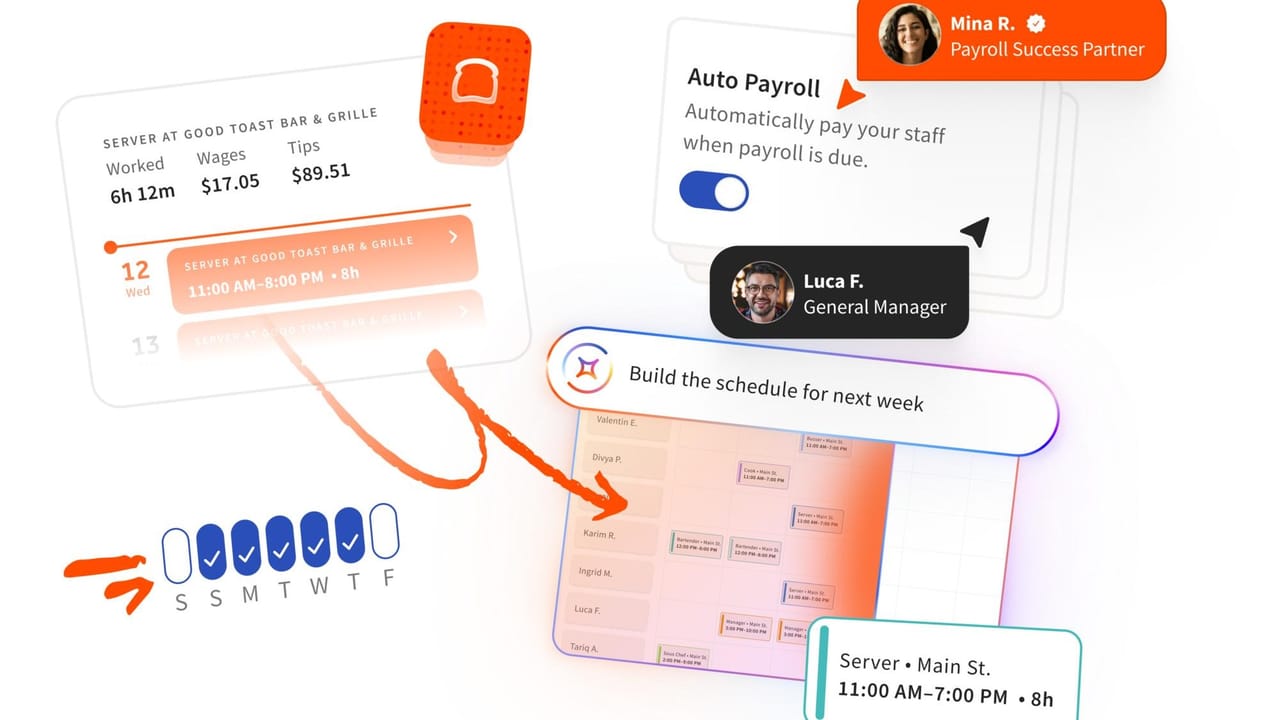
Toast IQ Team starts at $60 per month plus $9 per employee per month, according to Nation’s Restaurant News. Its agents focus on building schedules, anticipating sales, and encouraging teams to feature selected menu items.
– Scheduling Agent: Builds a labor schedule in seconds using employee availability, expected sales, and overtime risk. Toast says restaurants using its beta averaged 41% fewer overtime hours per employee than restaurants that did not. Treat that as a vendor-reported comparison, not a guaranteed result for your operation. Track overtime hours and schedule accuracy before and after rollout.
– AI-powered sales forecasts: Help managers plan staffing around expected demand. The value depends on whether forecasts improve the match between labor and actual covers, orders, and daypart patterns, not simply whether they look precise on a screen.
– Team Performance: Lets managers create menu-item contests in the MyToast employee app, with a live leaderboard. This may help drive sales of a featured item, but measure the item’s contribution margin and any incentive cost. More units sold do not automatically mean more profit.
For an initial fee check, use the formula $60 + ($9 × billed employees). At 20 employees, that equals $240 per month. If your fully loaded labor cost were $20 per hour, avoiding 12 hours of labor expense would equal $240. That is an illustrative break-even calculation, not a prediction, and savings need to be verified in your payroll and scheduling data.
Toast IQ Grow: demand generation, with a price hurdle
Visibility, guest feedback, offers, and campaigns
Toast IQ Grow starts at $699 per month. The package includes a human marketing manager, and Toast says its Marketing Agent identifies opportunities in past sales data and creates campaigns for operator approval. Toast described Grow as its fastest-growing new product ever in the NRN report.
– SEO Agent: Monitors online presence and identifies opportunities to improve visibility in search and AI-powered search. Check whether recommended changes increase qualified traffic, calls, online orders, or reservations.
– Reviews Agent: Prompts guests to review at selected points, such as online order confirmation. It can also route unhappy guests to a direct feedback channel and summarize review trends. Track review volume, rating trends, and whether feedback leads to fixes that improve guest retention.
– Offers Agent: Builds goal-based promotions from the restaurant’s historical data, including campaigns to win back lapsed guests. Set a contribution-margin limit before launching: a discount that brings a guest back at a loss is not a win-back strategy.
– Marketing Agent: Finds sales-based campaign opportunities and runs them with operator approval, while a human marketing manager can fine-tune the work. Measure campaign-attributed contribution after discounts and marketing costs, not just opens or clicks.
For Grow, the hurdle is straightforward: can the added contribution margin and any genuinely replaced marketing labor exceed $699 per month? Attribute results carefully. A campaign may get credit for a visit that would have happened anyway.

Early-access agents: useful tests, not automatic buys
Look for a specific operational problem
Toast has also teased early-access tools:
– Menu Agent: Suggests improvements to online menu content and pricing. Check recommendations against recipe costs, item mix, competitive positioning, and your brand. A price recommendation is not a substitute for menu engineering.
– Answering Agent: Answers phone calls. Test whether it handles common requests accurately and escalates exceptions gracefully. Guest relationships still need a human touch when the question is complicated, or the caller is upset.
– Configurable Agents: Use prebuilt templates for tasks such as catching missed clock-outs, flagging unusual voids, or forecasting prep needs. Start with one costly or error-prone workflow. Compare missed punches, void review time, or prep waste before and after.
These may be promising, but early access is not proof of fit. Confirm availability, limitations, and pricing for your operation before including them in a business case.
A practical checklist for evaluating the monthly fees
Run a focused test, then make the keep-or-cut decision
– Choose one measurable problem: If overtime is the issue, start with scheduling. If lapsed guests are the issue, test a win-back offer. Avoid launching several tools at once; otherwise, you may not know what moved the result.
– Set a baseline: Pull several weeks of comparable data for overtime, labor as a percentage of sales, campaign contribution, review trends, or prep waste. Account for seasonality, holidays, and changing business levels.
– Calculate net impact: Subtract subscription fees, discounts, incentives, and implementation time from verified savings or added contribution. Include the manager hours required to review and correct AI output.
– Keep a human in the loop: Assign someone to approve schedules, offers, menu changes, and sensitive guest responses. Automation should give managers more time for hospitality, not outsource judgment to a leaderboard.
– Check for tool sprawl: Before adding a product, ask whether your existing POS, scheduling, marketing, or guest-management system already solves the problem. Confirm how data moves between systems and who owns ongoing setup.

Make the technology prove its place on the P&L
We’ve worked every position in a restaurant, from busser to server to cook to manager to brewer to Director of Marketing. We know the schedule has to work for the floor, the kitchen, and the person trying to close payroll, not just the software demo.
The perspective we bring at Restaurant Finance Advisors, alongside RobertWKuypers, William Kuypers, and Robert Kuypers, is simple: technology should support restaurant operations optimization, improve restaurant margins, or unlock measurable restaurant growth. The National Restaurant Association projects a $1.55 trillion industry, but the operators who benefit most will still be the ones who manage the details.
If Toast IQ helps reduce restaurant costs or creates profitable demand, the numbers should show it. If not, even a cutting-edge agent is just another monthly charge. We help operators evaluate the broader restaurant tech stack alongside labor, marketing, capital, and growth priorities. Explore our restaurant services or contact our team to discuss your goals.
Visit us to learn more about maximizing your revenue, book a call to start making more money.
Sources
– Nation’s Restaurant News: Toast unveils an array of new AI agents for restaurants
– National Restaurant Association: Persistent cost increases and enduring demand will shape the restaurant industry in 2026
– National Restaurant Association: Same-store sales and customer traffic
Target keywords
restaurant tech stack, restaurant operations optimization, improve restaurant margins, reduce restaurant costs, AI in restaurants, restaurant scheduling, restaurant consulting, restaurant investment, restaurant growth, RobertWKuypers, William Kuypers, Robert Kuypers
Meta description
Explore Toast’s new AI agents for scheduling, marketing, reviews, and more. Learn how to evaluate fees, measure ROI, and improve restaurant margins.


