
Your guests won't tolerate another price increase, but your bottom line is screaming for relief. Welcome to the 2026 restaurant paradox: where inflation-weary diners are voting with their wallets, and operators are caught between rising costs and shrinking margins. Here's the truth: raising menu prices isn't always the answer. In fact, it's often the fastest way to accelerate your customer exodus.
The real opportunity? Found money. Not mythical windfalls or accounting tricks, but actual profit hiding in plain sight within your existing operations. We're talking about the $3,000 you're bleeding monthly on redundant tech subscriptions, the 15% labor inefficiency buried in your scheduling software, and the supply chain markup you've been paying for three years without questioning.
According to Toast's 2026 State of the Restaurant Industry report, 68% of operators cite margin pressure as their top challenge, yet only 22% have conducted a comprehensive operational audit in the past year. That gap represents opportunity: your opportunity to reclaim profit without alienating a single guest.
The Price Sensitivity Trap: Why You Can't Menu-Engineer Your Way Out
I've worked every position in a restaurant: from bussing tables at 16 to managing multi-unit concepts to consulting on eight-figure expansions. And I can tell you this: guests have never been more price-conscious than they are right now. They're comparing your burger price to three competitors before they even walk through the door.
The 2026 diner isn't just budget-aware; they're educated. They know what things should cost. They've read the same inflation reports you have, and they've made a calculation about what your food is worth to them. Push too hard on price, and you'll win the battle (higher check averages) but lose the war (fewer checks overall).
But here's what most operators miss: while you can't control market pricing pressures, you can absolutely control operational efficiency. The profit you need isn't in your guests' wallets: it's already in your four walls.
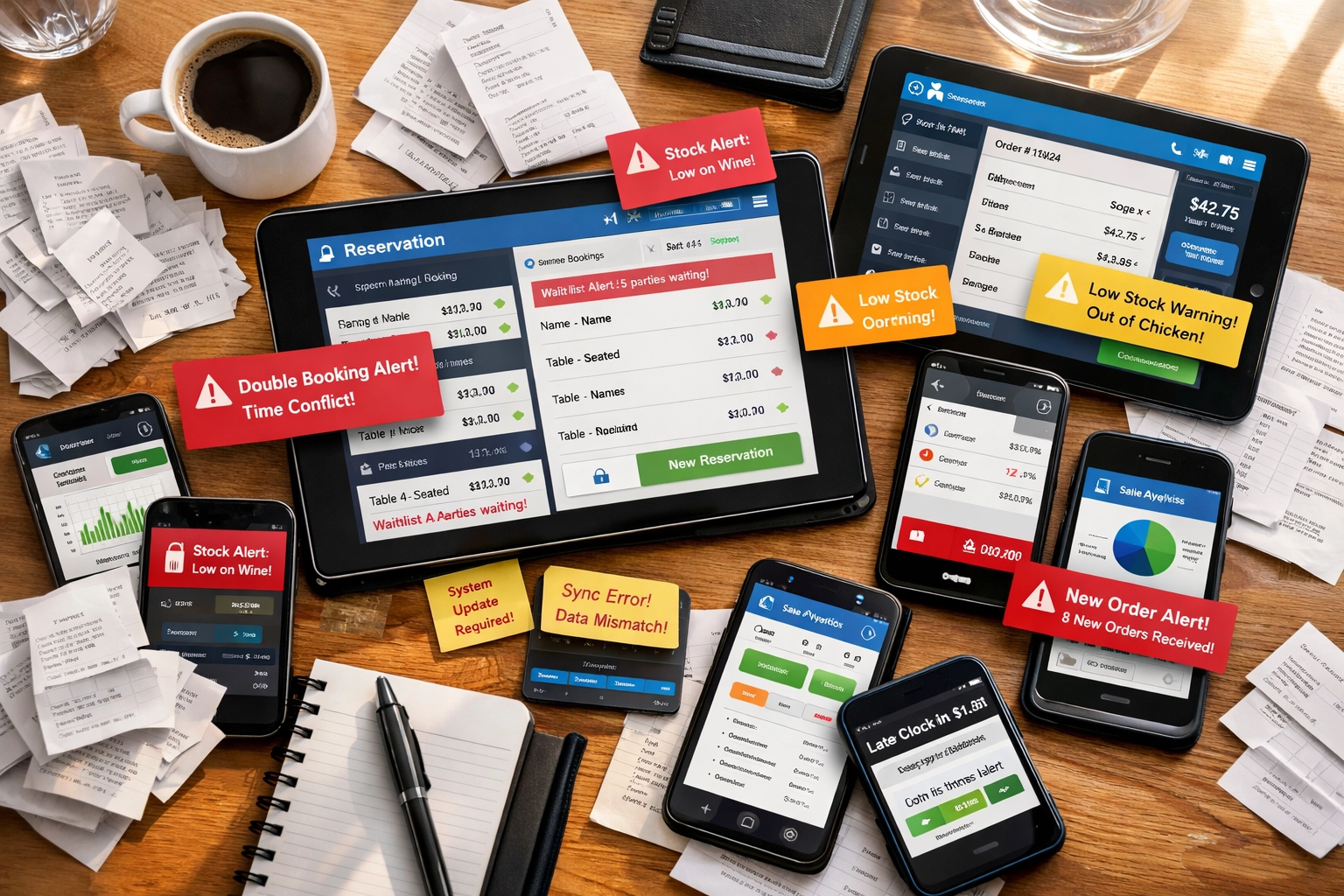
Found Money Area #1: The Tech Stack Time Bomb
Your technology should simplify operations, not complicate your P&L. Yet the average full-service restaurant in 2026 is running 11-14 different software platforms, many with overlapping functionality and zero integration. You're paying for:
– Three different reservation systems because you never fully migrated from the old one, kept the backup "just in case," and added the new one your chef's friend recommended
– Duplicate inventory management tools embedded in your POS, your accounting software, and that stand-alone system you bought at the NRA Show in 2023
– Marketing platforms you forgot you're still being charged for, including that email service you replaced with a better one eight months ago
We worked with a regional group last quarter that discovered $47,000 in annual software costs for platforms they no longer actively used. That's not profit optimization: that's finding a check that fell behind the couch.
The consolidation opportunity is massive. Modern integrated platforms can handle 70% of what you're cobbling together from multiple vendors. The question isn't whether to consolidate: it's how fast you can do it without disrupting service.
Found Money Area #2: Labor Scheduling's Hidden Margin Killer
Labor is your second-highest cost, and most operators are scheduling like it's still 2019. I've seen managers build schedules based on gut feel, historical patterns that no longer apply, and the dreaded "this is how we've always done it" approach.
Here's the reality: every percentage point of labor you can trim without sacrificing service quality falls straight to your bottom line. For a restaurant doing $3 million annually, a 2% labor efficiency gain equals $60,000 in found profit. Not revenue: profit.
The wins come from:
– Predictive scheduling based on actual traffic patterns, not last year's February that happened to include a snowstorm
– Strategic cross-training that reduces your need for specialized positions during shoulder periods
– Technology-enabled efficiency plays like QR code ordering during low-traffic periods that allow you to run one less server without degrading the guest experience
Chip Wade, the veteran hospitality leader who's turned around multiple major concepts, puts it simply: "You can't expense-cut your way to greatness, but you can absolutely eliminate waste on the path there."

Found Money Area #3: Supply Chain Arbitrage You're Not Exploiting
Your broadline distributor is convenient, but convenience has a price tag. Most operators are paying 8-15% premiums on items they could source more efficiently through specialty distributors, direct relationships, or buying cooperatives.
I'm not suggesting you become a procurement specialist overnight. But consider this:
– Your top 20 items by cost likely represent 60-70% of your total COGS spend. What happens if you optimize sourcing on just those 20 items?
– Direct dairy relationships for high-volume cheese and butter purchases can save 12-18% compared to broadline pricing
– Produce co-ops and farmer direct programs aren't just feel-good marketing: they're margin plays that also happen to support local agriculture
One concept we advise shifted their top-10 proteins to a specialty meat purveyor and saved $1,850 monthly. They're getting better quality, more consistent cuts, and padding their bottom line. That's $22,200 annually in found money from a single supply chain optimization.
The beauty of supply chain improvements? They're invisible to your guests. They don't know whether you sourced your ribeye from Sysco or Snake River Farms (okay, bad example: they'd probably notice that upgrade). But they definitely won't notice that you're saving 14% on your chicken breast through a direct relationship while maintaining the same quality standard.
Found Money Area #4: The Utility Audit Nobody Performs
When was the last time you actually scrutinized your utility bills? Most operators glance at the total, wince, and move on. But buried in those line items are opportunities: energy consumption patterns you can shift, peak usage periods you can mitigate, and efficiency upgrades that pay for themselves in 18-24 months.
We're not talking about going off-grid or installing solar panels (though that might make sense for your operation). We're talking about:
– LED retrofits that slash your lighting costs by 40-60% while improving kitchen visibility
– Smart thermostat systems that optimize HVAC without creating hot/cold zones that irritate guests
– Equipment right-sizing based on actual usage rather than theoretical capacity
A casual dining operator we worked with discovered their 20-year-old walk-in cooler was running at 40% efficiency. A $12,000 replacement investment saved them $380 monthly in electricity: that's a 32-month payback with another 8-10 years of efficient operation ahead.
The RFA Approach: Smart Funding Meets Operational Excellence
Here's where most consulting relationships break down: you pay hefty upfront fees for recommendations you may or may not be able to implement, and there's zero shared risk. The consultant gets paid regardless of whether you actually find any money.
We flipped that model entirely.
Our Smart Funding approach pairs operational optimization with capital for F&B credits: meaning we're only successful when you're successful. We're finding the money and helping you reinvest it immediately into high-ROI improvements. No upfront consulting fees. No 90-day diagnostic projects that produce beautiful PowerPoints and zero implementation.
– Risk-free operational audits that identify your top 10 margin improvement opportunities within two weeks
– Capital partnerships that fund the improvements without tying up your working capital
– Implementation support from operators who've actually worked the line, managed the chaos, and built the systems that last
We've helped operations unlock anywhere from $40,000 to $650,000 in annual found profit: not through menu price increases or cost-cutting that degrades quality, but through ruthless operational efficiency and strategic resource allocation.
The Two-Week Found Money Sprint
You don't need six months to start seeing results. Our typical engagement identifies the low-hanging fruit within 14 days:
Week One: Comprehensive operational audit covering tech stack, labor efficiency, supply chain, and overhead allocation. We're looking for quick wins and strategic opportunities.
Week Two: Prioritized action plan with immediate implementation on the top three opportunities. You start seeing margin improvement before the end of month one.
This isn't theoretical. We did this with a fast-casual chain last month and found $83,000 in annual savings from tech consolidation and supply chain optimization alone: before we even touched labor scheduling or utility efficiency.
Stop Leaving Money on the Table
The profit you need is already in your operation. It's hiding in redundant systems, inefficient processes, and legacy decisions that made sense three years ago but are actively costing you money today. Your guests are maxed out on price tolerance, but your operations still have room to breathe.
The question isn't whether found money exists in your restaurant: it absolutely does. The question is whether you're going to find it yourself or keep watching it walk out the back door month after month.
We're not consultants. We're partners. We find money you're currently leaving on the table, and we share the risk of implementation. When you win, we win. When you don't, we don't get paid. It's restaurant finance the way it should be: aligned, transparent, and obsessed with your bottom line.
Ready to stop guessing and start finding? Let's talk about what's possible in your operation.
Keywords: restaurant consulting, restaurant investment, restaurant new business, restaurant growth, find money your restaurants, profit optimization, operational efficiency, restaurant technology, labor optimization, supply chain management
Meta Description: Stop leaving money on the table. Discover how to boost your restaurant's bottom line through operational efficiency and smart funding without alienating your guests.
Outbound Link: Toast's 2026 State of the Restaurant Industry Report


