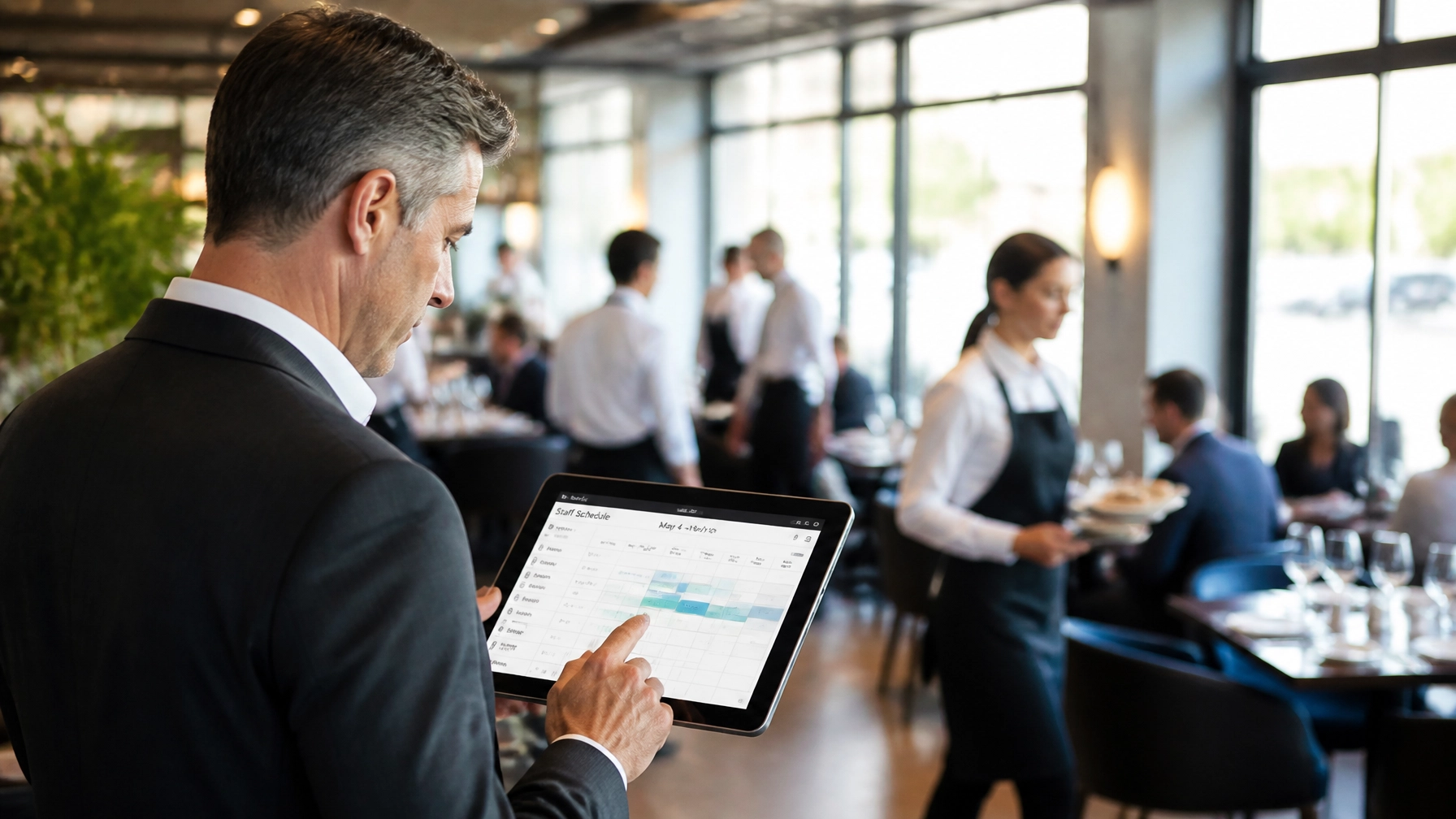
The labor crisis isn't a looming threat; it is the 2026 reality that is aggressively eating your margins alive. If you are still managing your roster with a dry-erase board and a prayer, you aren't just old school: you are losing money.
In today’s market, labor has ballooned to a staggering 35% of total operating expenses. Between rising minimum wages, complex "Fair Workweek" regulations, and a workforce that demands more flexibility than ever, the old ways of "gut-feeling" scheduling are dead. We’ve seen it across the board, from high-volume spots in New York City to growing concepts in Tampa.
I have worked every single position in this industry. I’ve been the busser dodging trays, the server getting double-sat on a Saturday night, the manager trying to find a dishwasher at 5:00 PM, and the Director of Marketing trying to explain why labor costs spiked 5 points. I’ve lived the chaos. That is why we are so focused on the tech that actually fixes the problem.
In this week’s Tech Spotlight, we are diving deep into 7shifts: the labor management powerhouse that has become the backbone of the modern restaurant tech stack. Here is how they are helping operators stay profitable in the most challenging labor environment we’ve ever seen.
Predictive Scheduling: Ending the Guessing Game
Most labor waste happens because of "just in case" scheduling. You schedule that extra server because you think it might be busy, only to watch them fold napkins for four hours while your P&L bleeds.

7shifts uses AI-driven labor forecasting to look at your historical POS data and predict exactly how many bodies you need on the floor. We aren't just talking about a rough estimate; we are talking about precision that can move the needle on your bottom line overnight.
– Automated Demand Forecasting – By integrating directly with your POS, 7shifts analyzes years of sales data to predict future traffic. We use this to ensure you are never overstaffed during a lull or drowning during a rush.
– Smart Labor Targets – You can set specific labor percentage goals within the app. If your schedule starts to creep past your target, the system flags it immediately, allowing you to make adjustments before the week even starts.
– Shift Swapping Without the Headache – Staff can trade shifts via their mobile app, which then requires manager approval. This keeps your team happy and your phone from blowing up with "can't make it" texts at midnight.
When we work with clients to optimize their tech stack, this is usually the first place we look. Reducing labor costs by even 2-3% through smarter scheduling can be the difference between a profitable month and a break-even one.
Navigating the 2026 Compliance Minefield
Labor laws in 2026 are a legal labyrinth designed to trip up the unwary operator. Between predictive scheduling laws, "Right to Rest" mandates, and overtime triggers, the cost of a single compliance mistake can wipe out a week’s worth of profit.
7shifts builds these rules directly into the platform. It doesn't just tell you who is working; it tells you who shouldn't be working.
– Proactive Overtime Alerts – The system tracks hours in real-time. If a cook is approaching 40 hours, the manager gets a notification. This prevents the "accidental overtime" that plagues unmonitored kitchens.
– Mandatory Break Tracking – In states with strict meal and rest break laws, 7shifts ensures employees are punching out when they should. It even provides an audit trail to protect you against "wage theft" lawsuits.
– Fair Workweek Integration – For operators in cities with predictive scheduling laws, 7shifts tracks schedule changes and calculates "predictability pay" automatically. This takes the guesswork out of complex local regulations.
We’ve seen restaurants turn their compliance around in under two weeks just by letting the software handle the heavy lifting. It’s not just about saving money; it’s about sleeping better at night knowing you aren't one audit away from a disaster.
The Engagement Score: Retaining the Talent You Have
Turnover is a profit killer. Replacing a single front-of-house employee costs roughly $1,000, and a back-of-house role can cost nearly $1,500. In 2026, where the "average" turnover cost is climbing toward $3,500 per employee when you factor in lost productivity, retention isn't a "nice-to-have": it's a survival strategy.

7shifts introduced the Engage dashboard to treat your staff like the assets they are. It’s about more than just a paycheck; it’s about feeling heard.
– Real-Time Shift Feedback – Employees can rate their shift on a scale of 1 to 5 as they clock out. If your star bartender gives three shifts in a row a "1," you know there’s a problem before they put in their two weeks.
– Engagement Analytics – Managers can see who is consistently late, who is picking up the most shifts, and who is disengaging. This data allows for proactive coaching rather than reactive firing.
– Earned Wage Access (EWA) – 7shifts integrates with tools like Clair to give staff immediate access to their earned wages. In a high-inflation world, this kind of financial flexibility is a massive differentiator that keeps staff loyal to your brand.
It’s a lot harder for a server to quit for a 50-cent raise down the street when they feel connected to their team and have instant access to their tips through your platform.
Multi-Unit Control and Executive Visibility
If you are growing, you cannot be in five places at once. For the independent owners we help scale into franchises, the biggest hurdle is often losing sight of what’s happening on the ground at Location B while they are at Location A.
The restaurant group reporting in 7shifts provides a "bird's-eye view" of your entire empire from a single login.
– Consolidated Labor Reporting – Compare labor costs across every location in your portfolio. If the labor at your Wichita spot is consistently higher than your Raleigh location, you can dive in and find out why.
– Standardized Operations – Ensure every location is following the same break and overtime protocols. This uniformity is essential for building a brand that is ready for investment or franchising.
– Centralized Communication – Send announcements to every employee across all locations with a single tap. Whether it’s a new menu launch or a holiday closing, everyone stays on the same page.
Why We Partner with Tech Leaders
At Restaurant Finance Advisors, we don't just write about these tools; we implement them. We know that the right tech stack is the foundation of a concept that can scale. Whether you are looking for smart funding to open your next five units or you need an operational turnaround to save the one you have, technology like 7shifts is a non-negotiable.

We take a risk-free approach. We only take a share of the results we create, meaning we are just as invested in your labor savings as you are. We’ve been in the dish pit, we’ve been in the boardroom, and we know exactly how to bridge the gap between the two.
Visit us to learn more about maximizing your revenue, book a call to start making more money.
Target Keywords
- restaurant tech stack
- reduce restaurant costs
- improve restaurant margins
- 7shifts labor management
- restaurant labor crisis 2026
- restaurant employee engagement
- AI labor forecasting
Meta Description
Discover how 7shifts is solving the 2026 restaurant labor crisis. Learn how AI-driven scheduling, compliance automation, and employee engagement tools can reduce costs and improve your restaurant's margins.


