Restaurant Intelligence
Two AI Agents Just Took Over Your Back Office: What Marble’s $5.5 Million Raise and SpotOn’s New Assistant Manager Mean for Your Prime Cost
By Robert W. Kuypers · Updated
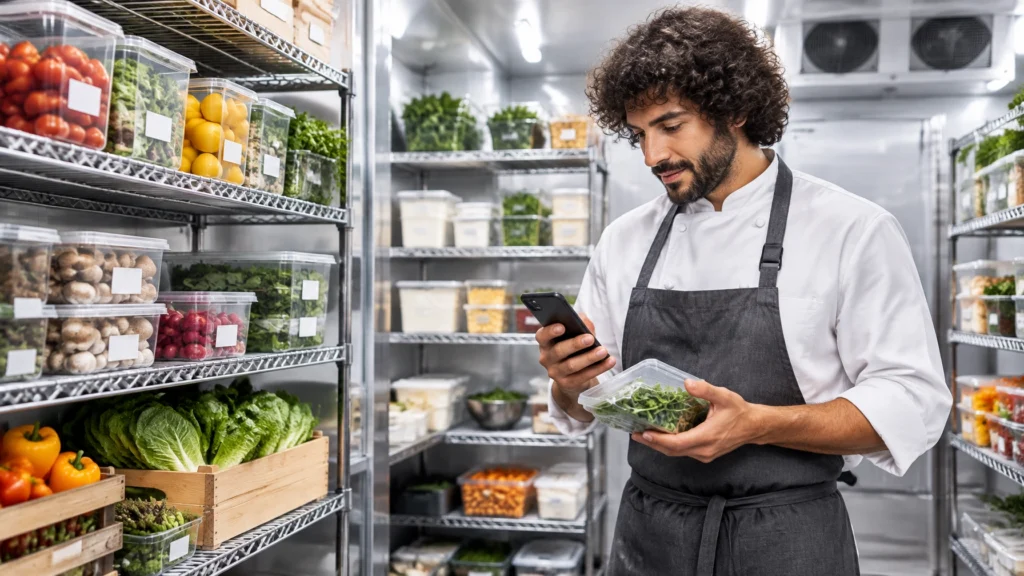
The next meaningful restaurant AI gains may come from the walk-in, not the drive-thru. On November 17, 2026, Marble and SpotOn announced AI agents aimed at back-office work: inventory, purchasing, prep, scheduling and cost analysis. A third signal arrived the same day, when Metafoodx introduced Chef Echo, an agentic assistant designed to flag overproduction and demand risk using historical production data.
That timing matters. Front-of-house AI often gets the headlines. But restaurant margins are shaped by what we buy, what we use, how we schedule, and what gets thrown away.
Why back-office AI is the margin story
The biggest costs still need daily attention
The National Restaurant Association says 33% of operators reported their restaurant was not profitable in the first half of 2026. Food and labor each account for roughly 33 cents of every sales dollar. Meanwhile, average hourly earnings for restaurant employees are up 41% since February 2020, and wholesale food prices are up 35%. Industry sales are projected to rise 4.3% in 2026, but traffic remains uneven and much of the growth reflects menu price increases. (National Restaurant Association)
Guest-facing tools can improve ordering and service. But they do not automatically correct an over-order, catch a case-size change or bring a schedule in line with the actual sales curve. Back-office technology can target those everyday decisions where food and labor costs meet.
We have worked every position in a restaurant: from busser and server to cook, manager, brewer and Director of Marketing. We know the difference between a clean report and a clean walk-in. The useful technology is the kind that connects the two.
Marble’s Remy targets the work behind an order
Faster counts are valuable only if the order is right
Marble announced a $5.5 million seed round led by Contrary, with participation from Y Combinator, Robinhood Ventures, Restive Ventures and angels including Sweetgreen co-founder Jonathan Neman. The company’s AI agent, Remy, a nod to Ratatouille, uses inventory records and demand forecasts to draft supplier orders, prep plans and employee schedules for a manager to review and approve. (Marble’s announcement; Contrary’s investment post)
Team members can speak inventory counts into Marble’s mobile app while walking storage areas; camera capture is also supported. Forecasts draw on sales history, reservations, weather and local events. At Sophie’s Cuban in New York, staff count stock by speaking Spanish into the app, then text Remy to draft vendor orders and transfers between locations.
What can this remove from a manager’s week?
– Handwritten counts: Capture counts while walking the cooler instead of re-entering notes later.
– Pack-size conversions: Translate “two cases and half an open case” into usable stock and ordering units. Provided item and packaging data are mapped correctly.
– Supplier substitutions and case changes: Surface changes that can throw off an order even when yesterday’s count was accurate.
– Invoice reconciliation: Compare what was ordered with what arrived and what the invoice says, rather than relying on memory and a stack of paper.
– Prep and schedule drafts: Start with a forecast informed by sales history and local conditions, then let a manager review the plan.
Marble integrates with 7shifts, Sling and HotSchedules for labor, and QuickBooks and Restaurant365 for accounting, so operators may be able to keep existing systems. It enters a field that also includes MarginEdge, whose published base price is $350 per location per month plus add-ons, Restaurant365 and Toast’s xtraCHEF.

The honest test is what happens after the draft
Contrary says Marble signed more than 150 restaurants in under four months. Marble’s CEO Aakar Khanna told Restaurant Business the typical monthly price is $250–$450 depending on location count and reported savings of 20–30 staff hours a week and a 30%–40% reduction in food waste. Early customers have also reported roughly 40% less food waste and more than 20 labor hours saved weekly. These are vendor- or investor-reported figures, not independently verified results.
There are practical failure points to test:
– Ingredient mapping errors: A count assigned to the wrong item or unit can create a confidently wrong order.
– Orders that do not reach the distributor portal: A draft is not a delivery. Confirm how approved orders are transmitted and acknowledged.
– Forecasts based on sold-out items: Sales history can understate real demand when a popular dish ran out early. The forecast needs context, not just the register total.
– Substitutions and invoice mismatches: Check whether the system catches a different brand, pack size or price, and how exceptions get resolved.
The honest test is to follow several orders through the full chain: count, approval, distributor receipt, delivery, invoice and service. The goal is not a persuasive demo. It is fewer corrections, less waste and reliable availability when guests order.
SpotOn’s Sam puts business questions within reach
Start with four numbers you should know cold
SpotOn introduced SpotOn Assistant Manager, or Sam, its first AI agent in SpotOn Intelligence, on November 17. Operators can ask plain-language questions about sales, labor, purchasing and costs, then build custom reports. Sam works on desktop, mobile and two-way text, 24/7, in English and Spanish. It connects SpotOn sales, labor, kitchen display and guest data with third-party sources such as weather, local events, accounting, inventory and reviews. (SpotOn’s announcement)
SpotOn reports that its average client had nearly five conversations with Sam per month, with text accounting for more than 17% of conversations. Common requests included quick sales checks and custom reports on daily sales, product mix by day and payment method. The company plans to add agentic capabilities for routine tasks; APIs are expected in Q1 2027.
The Weinberger’s Deli case study shows why seeing the numbers together matters. The independent Grapevine, Texas restaurant expanded this year. Owner Dan Weinberger reported labor at 44% of sales, food cost at 30% and prime cost at 74%, against a 63% goal. He says the business saved about $124,000, largely by cutting food cost 3.5%, and now uses Sam for daily scheduling, food-cost comparisons and sales predictions he previously assembled by hand. Those savings are company-reported.
The diagnosis is the key lesson: the operator could not see the gap until the numbers were put in one place. That is a reporting and operating-discipline problem first, and a software problem second.
Every operator should be able to recite four figures without opening a dashboard:
– Food cost: What share of sales goes to food and beverage product?
– Labor cost: What share goes to wages and related labor expense?
– Prime cost: What do food and labor total as a percentage of sales?
– Target prime cost: What is the goal for this concept, and how far are we from it?
Most independents cannot answer all four consistently by daypart or by location. AI may make the answer faster. It cannot decide what the target should be, or ensure the team acts on it.

A no-purchase-required margin playbook
Build a baseline before you buy another tool
Before adding software, put a repeatable routine in place. We recommend starting here:
– Count the top 20 items: Focus on the ingredients that drive most food spend. Count them the same way, on a consistent schedule.
– Compare purchased with sold: For four weeks, compare purchases with theoretical usage from sales and recipes. Investigate meaningful variances instead of treating them as inevitable.
– Track prime cost by daypart and store: Weekly totals can hide a lunch labor issue or a location that consistently runs over target.
– Schedule against the sales curve: Compare each shift’s planned labor to expected sales by hour. Do not copy last year’s schedule just because it is familiar.
– Pilot one tool against a written baseline: Record current hours spent ordering, count accuracy, waste, stockouts and prime cost. Then test one tool against those measures.
This is where a manager learns whether technology removes work or simply gives the work a new login screen. For RobertWKuypers, William Kuypers and Robert Kuypers, the operating principle is the same: use technology to make decisions clearer, then measure whether the decisions improve the business.
Technology should support the operating plan
Prove the opportunity before scaling the spend
At Restaurant Finance Advisors, we approach restaurant turnaround work on a risk-free basis: we are paid from results we create rather than upfront fees. Our smart funding model can provide capital through a partner in exchange for food and beverage credits, with no interest and no equity dilution. Both approaches start with the economics and the opportunity, not a software pitch.
For owners building a restaurant tech stack, planning restaurant growth or trying to improve restaurant margins, the practical question is not whether AI can produce an answer. It is whether the answer changes purchasing, prep or scheduling, and whether the improvement shows up in the numbers.
Visit us to learn more about maximizing your revenue, book a call to start making more money.
Target keywords
restaurant consulting, restaurant investment, restaurant growth, profit optimization, restaurant operations optimization, restaurant funding, smart funding for restaurants, franchise development, restaurant turnaround, improve restaurant margins, reduce restaurant costs, restaurant tech stack, restaurant capital, RobertWKuypers, William Kuypers, Robert Kuypers
Meta description
See how new restaurant AI agents target inventory, purchasing and labor, and what operators can measure to improve restaurant margins.
Sources
– Marble raises $5.5 million to automate restaurant inventory and purchasing with AI
– Contrary: Investing in Marble
– SpotOn Assistant Manager AI agent
– Metafoodx introduces Chef Echo, an agentic AI assistant for commercial kitchens
– National Restaurant Association: Restaurants remain resilient despite challenging business conditions
Share this article on LinkedIn
Is cash getting tight?
Run your numbers in the free RFA Opportunity Analysis. Two minutes, no email required.
Explore Build More → Find My Hidden Money →