

Your restaurant doesn't have a technology problem, it has a technology overload problem. And if you're like most operators heading into the back half of 2026, that crowded tech stack is quietly bleeding your margins dry while promising you the world.
I've been in this industry long enough to remember when the most complicated piece of technology in a restaurant was the fax machine for supplier orders. Now? The average multi-unit operator juggles somewhere between 12 and 20 different software subscriptions. Scheduling. Inventory. POS. Loyalty. Delivery aggregators. Employee training platforms. Analytics dashboards you haven't logged into since the free trial ended.
Here's the uncomfortable truth: adding more subscriptions isn't a growth strategy, it's a distraction disguised as progress.
The Data Doesn't Lie: Confidence Is at Rock Bottom
According to TouchBistro's 2026 State of Restaurants Report, double-digit margins are absolutely achievable through tech-driven resilience. That's the good news. The bad news? Only 18% of operators feel confident in their ability to forecast accurately.
Let that sink in. We have more data at our fingertips than any generation of restaurateurs before us, yet fewer than one in five operators trust their ability to predict what's coming next month, let alone next quarter.
This isn't a failure of technology. It's a failure of integration. When your systems don't talk to each other, when your POS doesn't sync with your inventory, when your scheduling software has no idea what your labor targets are, you're not running a smart operation. You're running a digital junk drawer.
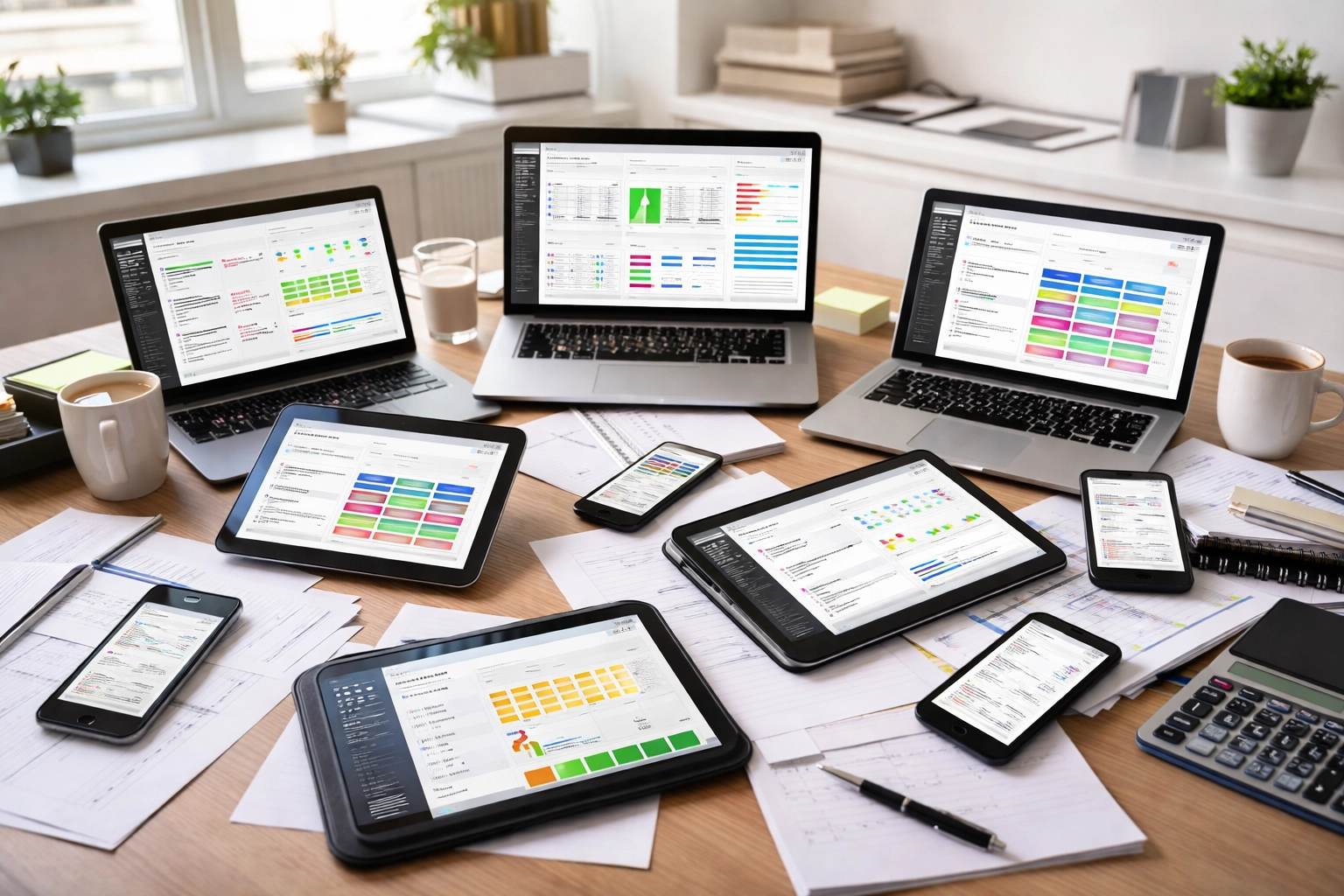
Tech Fatigue vs. Tech Strategy: Know the Difference
Tech fatigue is real, and it's costing you money. I've seen GMs spend more time troubleshooting software logins than actually managing their teams. I've watched kitchen managers juggle three different tablets just to place a produce order. And don't even get me started on the manager who has to export data from four platforms into a spreadsheet just to get a basic P&L snapshot.
That's not strategy. That's survival mode.
A true tech strategy asks different questions:
– What problems are we actually solving? – Not "what's the shiniest new app," but what specific operational pain points need addressing
– How do these systems integrate? – If the answer is "they don't," you've got a problem that will compound monthly
– What's the total cost of ownership? – Subscription fees are just the beginning; factor in training time, troubleshooting, and the opportunity cost of fragmented data
– Are we measuring outcomes or just activity? – Dashboards that show you what happened are worthless if they can't help you predict what's next
As Jonathan Maze has noted in his analysis of the industry's "Maturation Moment," we're moving past the era of growth-at-all-costs into a phase of recalibration. Operators who thrive in 2026 and beyond won't be the ones with the most tools, they'll be the ones who use fewer tools more effectively.
The Rise of Predictive Intelligence (And Why 74% of You Want It)
Here's what's fascinating: according to Starfleet Research, 74% of restaurant operators express strong interest in predictive intelligence capabilities. That's nearly three-quarters of the industry raising their hands saying, "Yes, please tell me what's going to happen before it happens."
And yet, most tech stacks aren't built for prediction. They're built for reaction.

Your current systems probably excel at telling you that labor was 2% over budget last Tuesday. Cool. What they don't do is tell you that this Tuesday: with the weather forecast, the local event schedule, and your historical traffic patterns: you should cut a server from the floor at 3 PM and add a prep cook at 4 PM.
That's the difference between reporting and intelligence.
The NRN Tech Tracker highlights this shift perfectly: the resolution for restaurant tech in 2026 isn't "buy more": it's "integrate smarter." The operators winning right now are the ones embedding AI and automation directly into their existing workflows, not bolting on yet another standalone platform.
The Hidden Cost of "More"
Let me paint a picture that might feel familiar.
You're a regional operator with 8 locations. Over the past three years, you've added:
– A new loyalty platform (because the old one wasn't "engaging" enough)
– A kitchen display system (because tickets kept getting lost)
– An employee scheduling app (because your old one didn't have shift-swapping)
– A third-party delivery management tool (because juggling DoorDash, Uber Eats, and Grubhub on separate tablets was a nightmare)
– A "business intelligence" dashboard (because you needed to see "the big picture")
Total additional monthly spend? Probably somewhere between $1,500 and $3,000 across all locations. That's $18,000 to $36,000 a year in subscription costs alone.
But here's the question nobody's asking: Is any of it talking to each other?
McKinsey's research on what US consumers want from restaurants makes it clear that efficiency and value are paramount. Your guests don't care how many platforms you use: they care about speed, accuracy, and consistency. If your tech stack isn't delivering that, it's not an asset. It's overhead.

Simplification as a Growth Strategy
The operators seeing double-digit margins in 2026 aren't adding: they're subtracting. They're asking hard questions like:
– Which of these subscriptions are actually driving measurable outcomes?
– Where do we have redundant functionality across multiple platforms?
– What can we consolidate, automate, or eliminate entirely?
This mirrors what's happening across every industry. The era of unlimited, fragmented subscriptions is ending. Streaming services are scaling back libraries and focusing on bundles. Enterprise software is moving toward "Service-as-Software" that runs itself. AI in 2026 is less about flashy new products and more about task-specific systems integrated quietly into everyday workflows.
Change feels less like an event and more like a slow recalibration. The restaurants that recognize this shift early will find money hiding in their operations: money that's currently being spent on tools they don't fully use, data they don't fully trust, and integrations that don't fully work.
What RFA Does Differently
At Restaurant Finance Advisors, we don't sell software. We don't get kickbacks from vendors. We have zero incentive to add another subscription to your stack.
Our approach is built on a simple premise: find the money that's already there.
– Full tech stack leadership and implementation – We audit everything you're currently paying for, identify redundancies, and build a roadmap that actually makes sense
– Predictive intelligence integration – We help you move from reactive reporting to proactive decision-making
– Risk-free engagement – We find wins in under two weeks, or you don't pay. Period.
We don't just add subscriptions; we optimize the ones you have and remove the ones you don't need. Because in 2026, the smartest restaurant growth strategy isn't about having more technology: it's about having the right technology, working together, driving actual results.
The Bottom Line
Your tech stack should be a competitive advantage, not a monthly migraine. If you're spending more time managing your tools than your operations, something's broken.
The path to double-digit margins in 2026 runs through simplification, integration, and predictive intelligence: not another shiny app with a free trial.
Ready to stop feeding the subscription machine and start finding real money in your operations? Get a risk-free tech and operations audit from RFA. We find the wins in under two weeks: or you don't pay.
Keywords: restaurant consulting, restaurant investment, restaurant growth, find money your restaurants, restaurant tech stack
Meta Description: "Is your tech stack eating your margins? In 2026, the key to restaurant growth isn't more software: it's smarter integration. Learn how to simplify for profit."
Outbound Links:


