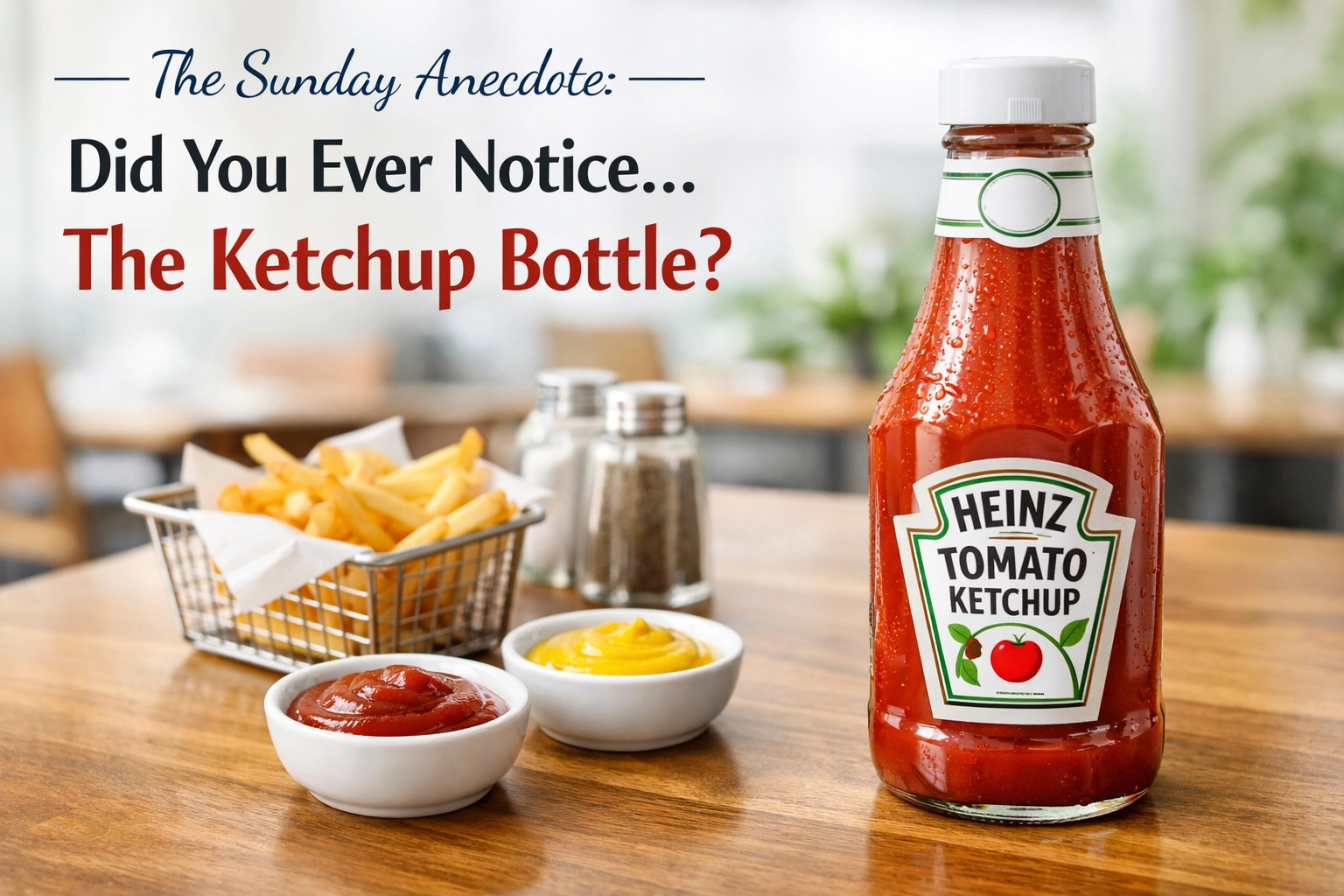
Did you ever notice that some of the most frustrating things in the restaurant industry are the ones we have simply accepted as "the way it is"? We spend our lives in this business navigating a sea of quirks, strange habits, and operational "traditions" that make about as much sense as a screen door on a submarine. I’ve spent thirty years in this game, from the sticky floors of the dish pit to the polished mahogany of the boardroom, and if there is one thing I’ve learned, it’s that we are often our own worst enemies when it comes to efficiency.
Take, for example, the humble ketchup bottle.
We’ve all been there. You’re sitting at a diner, or perhaps you're the manager watching a frustrated guest at Table 4. They’ve got the burger. They’ve got the fries. But the ketchup, that thick, stubborn tomato nectar, is trapped inside a glass bottle like a genie that refuses to grant a wish. They shake it. They pound the bottom of it. They try the "secret" trick of tapping the '57' embossed on the neck. It’s a ritual. It’s a dance. And frankly, it’s a waste of everyone’s time.
The Evolution of the Pour: A Lesson in Adaptability
Operational efficiency is often hidden in the most mundane objects we overlook every single day. For decades, the restaurant industry stayed married to the glass bottle because it looked "premium." We prioritized the aesthetic of the glass over the actual utility of the sauce. It wasn’t until 1983 that the squeezable plastic bottle arrived, and even then, we had to wait until 2002 for the "upside-down" revolution.
Think about that for a second. It took over a hundred years to realize that if you want a heavy liquid to come out of a container, you should probably store it with the opening facing down.
In our world of restaurant consulting, we see "glass bottle" thinking everywhere. We see operators clinging to manual inventory systems that take six hours to complete when a digital solution could do it in twenty minutes. We see "the way we’ve always done it" acting as a massive anchor on profitability. At Restaurant Finance Advisors, we believe that if you aren't willing to flip your "bottle" upside down, you’re literally leaving money on the bottom of the jar.

Identifying the "Ketchup Bottle" Inefficiencies in Your Operation
Every restaurant has a hidden "ketchup bottle", a process that is unnecessarily difficult, time-consuming, or wasteful. These aren't just minor annoyances; they are financial leaks that drain your margins one cent at a time. Whether you are running a single unit or looking into restaurant investment for a national rollout, identifying these bottlenecks is the first step toward true growth.
– The "Dark Art" of Manual Scheduling – We often see managers spending half their Sunday huddled over a spreadsheet, trying to play Tetris with employee availability. This isn't just a labor cost; it’s an opportunity cost. Every hour a manager spends on a schedule is an hour they aren't on the floor driving guest satisfaction or training staff to upsell that second appetizer.
– Ghost Inventory and Waste – Did you ever notice how the most expensive ingredients seem to have the shortest shelf lives? When we audit a new client's kitchen, we often find that "the bottle is stuck" because of poor rotation or over-ordering. This is "stuck money" that eventually ends up in the dumpster behind the building.
– The Tech Debt Trap – Many restaurant new business ventures launch with legacy POS systems that don't talk to their accounting software. They’re essentially trying to get ketchup out of a glass bottle with a toothpick. We advocate for seamless integration that allows data to flow as freely as… well, you get the metaphor.
Why We Cling to the Old Ways (And Why It Costs You)
Human nature dictates that we prefer the "devil we know" over the innovation we don't. I remember back when I was a brewer, then a Director of Marketing; I’d watch staff struggle with outdated equipment or convoluted POS screens, and when I’d ask why, the answer was always: "That’s just how we do it here."
But "how we do it here" doesn't pay the rent in New York City or Los Angeles. In high-rent districts, every second of labor and every ounce of product must be optimized.
If Paul Brown, the inventor of the silicone valve for the upside-down bottle, had listened to the skeptics, he wouldn't have made $13 million selling his design to the big players. He saw a problem: gravity: and he engineered a solution. As restaurant growth experts, we look for the "gravity" in your business: the forces pulling your profits down: and we engineer the valves to let the revenue flow.
Finding the Money Hiding in Plain Sight
To find money in your restaurants, you have to be willing to look at your operations through a lens of extreme skepticism. We encourage our partners to question everything. Why do we prep the lemons this way? Why are we using this specific vendor for linens? Is there a reason our utility bills are 20% higher in Tampa than in Sacramento?
– Audit Your Workflow – Walk through your line during a rush. If your cooks are crossing paths like a game of Frogger, your kitchen layout is a "glass ketchup bottle." A simple reorganization of the line can shave seconds off every ticket, which translates to higher table turnover and happier guests.
– Analyze Your Menu Mix – Are you keeping items on the menu simply because one regular customer orders them once a month? High-overhead, low-velocity items are the "dregs" at the bottom of the bottle. They take up space and offer no reward.
– Leverage Expert Eyes – Sometimes, you’re too close to the problem. You’ve been staring at the bottle so long you’ve forgotten it can be squeezed. Bringing in a firm like Restaurant Finance Advisors provides that outside perspective needed to identify where the flow is blocked.

The Upside-Down Strategy for 2026 and Beyond
The future of the restaurant industry belongs to those who are agile enough to flip the script. We aren't just talking about condiments; we are talking about a fundamental shift in how we view the business of hospitality. Whether you're operating in Raleigh, Salt Lake City, or Washington D.C., the principles of efficiency remain the same.
We’ve seen it time and again: a small change in process leads to a massive change in the bottom line. It’s about creating a culture where "that’s how we’ve always done it" is a banned phrase. Instead, we ask, "How can we make this flow better?"
Did you ever notice that when the ketchup finally does come out of that glass bottle, it usually comes out all at once, ruining your fries? That’s what happens to operators who wait too long to innovate. They stay stagnant until a crisis hits, and then they try to change everything at once, causing a mess that’s hard to clean up.
True success is found in the controlled, engineered flow of a well-oiled machine.
We’ve worked every position in the house. We know the struggle of the server waiting for a slow pour, and we know the stress of the owner looking at a narrowing margin. At Restaurant Finance Advisors, we don't just point out the bottle is stuck; we give you the tools to squeeze every last drop of profit out of your operation.
Visit us at www.restaurantfinanceadvisors.com to learn more about maximizing your revenue and book a call today to start making more money. Our team, led by experts like Robert Ancill, is ready to help you find the "hidden money" in your restaurants.
Don't spend another Sunday whacking the bottom of a glass bottle. Let's flip your business upside down and see how much faster the success flows.
Keywords: restaurant consulting, restaurant investment, restaurant new business, restaurant growth, find money your restaurants.
Meta Description: Did you ever notice how some restaurant habits just don't make sense? Join us for a witty, Andy Rooney-style Sunday anecdote about the quirks of the industry and how to find the hidden money in your restaurant operations.
Sources:


