
The biggest winners in the restaurant industry right now aren't adding more: they're ruthlessly cutting. And before you roll your eyes at another "do more with less" platitude from consultants who've never worked a Friday night rush, hear us out. We've got the receipts, and they're showing 31% same-store sales growth.
If you've spent any time on the line, behind the bar, or managing a dining room floor, you know exactly what operational bloat feels like. It's the seventh tablet on your host stand. It's the menu item nobody orders but somehow requires three specialty ingredients. It's the "integrated" tech stack that requires a PhD in workarounds to function.
The smartest operators in 2026 aren't playing that game anymore. And the results are speaking louder than any keynote speech.
The Chili's Phenomenon: How Kevin Hochman Turned Simplicity Into a 31% Sales Surge
Kevin Hochman didn't reinvent the wheel at Brinker International: he just stopped adding unnecessary spokes. When the former KFC executive took the helm at Chili's parent company, industry watchers expected the typical turnaround playbook: new menu innovation, flashy marketing campaigns, maybe some trendy limited-time offers.
Instead, Hochman went the opposite direction. He simplified the menu, streamlined operations, and refocused the entire organization on executing the basics with excellence. The result? Brinker International reported a stunning 31% same-store sales increase, making Chili's one of the most remarkable turnaround stories in recent casual dining history.
Here's what made the difference:
– Menu reduction – Fewer items meant faster ticket times, reduced waste, and kitchen staff who could actually master every dish rather than fumbling through 47 different preparations
– Operational focus – Instead of chasing every trend, teams zeroed in on speed, accuracy, and hospitality fundamentals
– Value clarity – Customers knew exactly what they were getting, and they came back for it
As someone who's worked every position from busser to Director of Marketing, I can tell you: nothing kills a kitchen faster than complexity. When your line cooks are juggling too many moving parts, something always drops: usually your ticket times and your margins.

Starbucks Gets the Memo: Brian Niccol's 30% Menu Cut
If Chili's turnaround wasn't enough evidence, Starbucks just confirmed that simplification is the strategy of the moment. New CEO Brian Niccol: the mastermind behind Chipotle's operational renaissance: announced plans to cut the Starbucks menu by approximately 30%.
Think about that for a second. One of the most successful restaurant brands on the planet is actively making itself smaller.
Niccol's reasoning is pure operational wisdom: speed and service quality suffer when baristas are expected to execute an encyclopedia of drink combinations. By pruning the menu, Starbucks can:
– Reduce average ticket time – Fewer options means faster execution and shorter drive-thru lines
– Improve consistency – Baristas become experts at a focused menu rather than generalists struggling with complexity
– Enhance customer satisfaction – Paradoxically, customers often prefer fewer choices presented well over endless options delivered poorly
We've seen this movie before in our restaurant consulting work. The operators who obsess over "giving customers everything they want" often end up delivering mediocrity across the board. The ones who pick a lane and dominate it? They build loyal followings and healthy margins.
The Tech Stack Trap: Where Your "Hidden Money" Is Actually Hiding
Here's where simplification gets really interesting for your bottom line. Most restaurant operators we work with are bleeding money through tech bloat, and they don't even realize it.
Think about your current technology ecosystem. How many of these sound familiar?
– The POS system that doesn't talk to your inventory management
– The scheduling app that requires manual data entry into your payroll system
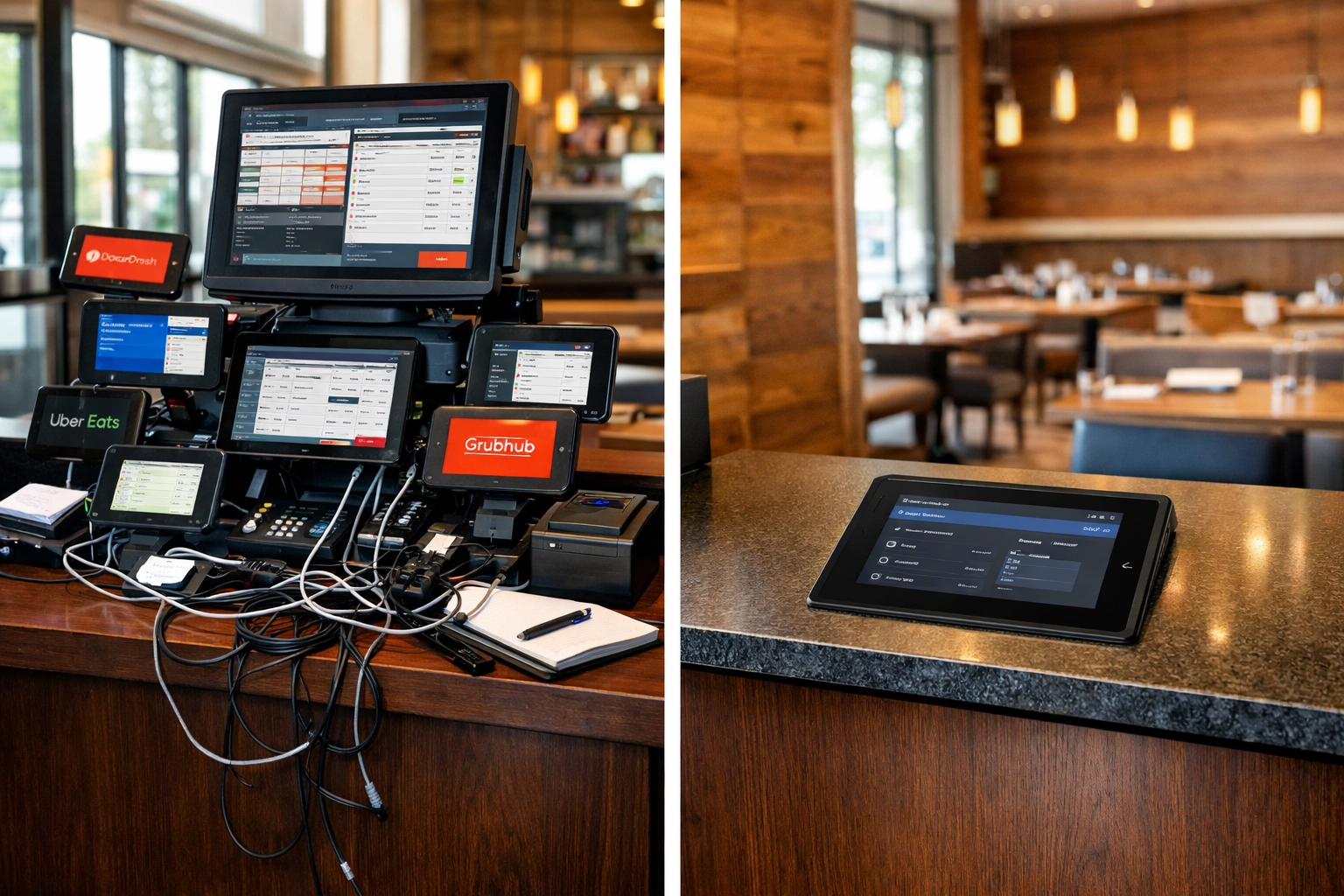
– The delivery tablet graveyard on your host stand (DoorDash, Uber Eats, Grubhub, maybe a fourth one nobody uses)
– The loyalty program that sends data to a dashboard nobody checks
– The reservation system that duplicates information already in your CRM
Each one of these tools probably seemed like a great idea when you signed up. Each one probably promised to solve a specific problem. But collectively? They're creating operational friction, training headaches, and subscription fees that add up faster than a Saturday night bar tab.
Finding Money in Your Restaurant: The RFA Approach
At Restaurant Finance Advisors, we specialize in helping operators find money in their restaurants that's been hiding in plain sight. And more often than not, that money is trapped inside unnecessary complexity.
Our tech stack leadership approach starts with a simple question: What is this tool actually doing for your operations, and is there a simpler way to achieve the same result?
The answers often surprise even experienced operators:
– Consolidation opportunities – Many restaurants can eliminate 3-4 software subscriptions by choosing platforms that actually integrate
– Training time reduction – Simpler systems mean faster onboarding and fewer mistakes from new team members
– Data clarity – When you're not drowning in dashboards, you can actually see what matters
– Margin recovery – The combination of reduced subscriptions, faster operations, and fewer errors flows directly to your bottom line
Here's what makes our approach different: we don't charge upfront fees. Our restaurant investment philosophy is built on shared success. If we can't find money in your operation, you don't pay us to look for it. That's how confident we are that simplification works.
The Psychology of Simplification: Why Customers Reward Less
The "less is more" strategy isn't just operationally smart: it's psychologically powerful. Modern consumers are drowning in choice. Every scroll through their phone presents infinite options. Every streaming service offers thousands of titles. Every grocery store aisle features dozens of variations of the same product.
Decision fatigue is real, and restaurants that acknowledge this reality win customer loyalty.
When you walk into a Chili's today, you're not overwhelmed by a 47-page menu. You see focused offerings executed with confidence. When your Starbucks order arrives in 90 seconds instead of five minutes, you remember that experience.

The research backs this up: strategic subtraction creates competitive advantage by removing friction that no longer adds value. Companies like Bang & Olufsen have built entire luxury brands around elegant minimalism. The same principles apply to restaurant operations, whether you're running a fine dining concept or a quick-service chain.
Your Simplification Playbook: Where to Start
Ready to find the hidden money in your restaurant? Here's our recommended approach:
– Audit your tech stack – List every software subscription, tablet, and system. Ask honestly: does this make us money or cost us money?
– Review your menu – Identify the bottom 20% of items by sales volume. What would happen if they disappeared tomorrow?
– Time your operations – Where are the friction points that slow down service? Often, they're connected to complexity
– Talk to your team – Your line cooks and servers know exactly what's slowing them down. Listen to them
– Measure reduction, not just growth – Track metrics like ticket time, training duration, and error rates alongside traditional KPIs
The operators achieving restaurant growth in 2026 aren't the ones adding features. They're the ones with the discipline to subtract.
The Bottom Line: Simplification Is a Competitive Advantage
Kevin Hochman at Chili's and Brian Niccol at Starbucks didn't stumble onto this strategy by accident. These are seasoned industry veterans who understand that complexity is the enemy of execution.
At Restaurant Finance Advisors, we've built our entire consulting practice around this principle. We help operators cut through the noise, identify what actually drives profitability, and build streamlined operations that scale.
The question isn't whether simplification works. The evidence from the biggest names in the industry proves it does. The question is whether you're ready to stop adding and start subtracting.
We're ready to help you find the answer: and the money hiding inside your operation.
Keywords: restaurant consulting, restaurant investment, restaurant growth, find money your restaurants, restaurant simplification, tech stack optimization, menu simplification, operational efficiency, restaurant margins, Brinker International, Chili's growth strategy, Starbucks menu reduction
Meta Description: Discover why restaurant simplification is driving 31% sales growth at Chili's and major changes at Starbucks. Learn how to find hidden money in your restaurant by cutting tech bloat and operational complexity with Restaurant Finance Advisors.
Outbound Links:


