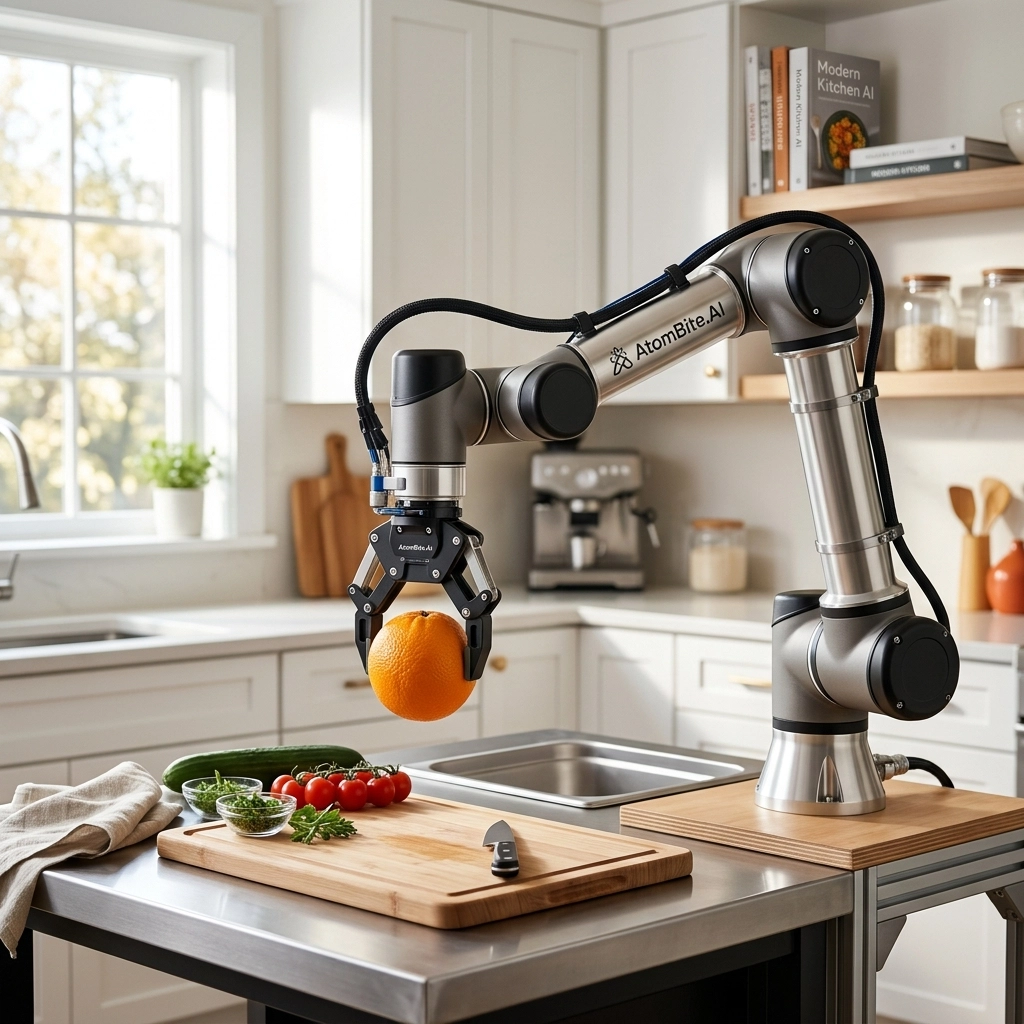
Automation in the kitchen has always been a game of inches, but the "last meter": that frantic moment when hot food is funneled into a bag: has remained a stubborn, manual bottleneck that costs operators billions in labor and errors. For decades, the robotics industry has promised us a future where machines handle the heavy lifting, yet they’ve consistently stumbled over the simplest of tasks: picking up a crushed paper bag or securing a leaking soup container. At Restaurant Finance Advisors, we’ve seen every "next big thing" come and go, but the recent breakthroughs from AtomBite.AI suggest we are finally crossing the threshold from experimental novelty to operational necessity.
Having spent my life in this industry: moving from the chaos of a Friday night busser to the high-stakes decisions of a Director of Marketing and now a restaurant consultant: I know that the kitchen is a war zone of unstructured variables. It’s messy, it’s hot, and nothing is ever where it’s supposed to be. While a robot in a car factory handles the same rigid steel part a thousand times, a restaurant robot has to deal with a soggy bag one second and a rigid plastic lid the next. This is what engineers call the "grasping problem," and AtomBite.AI might have just solved it.
The Grasping Problem: Why Your Kitchen Isn’t Automated Yet
The fundamental reason most kitchen automation fails isn't a lack of mechanical power, but a lack of cognitive flexibility. In a laboratory, a robot can be programmed to pick up a perfect cube 100% of the time. In a real-world kitchen, however, the "objects" are constantly changing. A paper bag deforms when you touch it. A plastic cup shifts its center of gravity as the liquid sloshes around. A receipt might be fluttering in the breeze of an HVAC vent.

Traditional robots are "blind" in the sense that they follow pre-programmed paths. If the bag is two inches to the left or slightly crumpled, the robot misses, the food spills, and the kitchen manager ends up throwing the machine into the alley in a fit of rage (we’ve all been there). AtomBite.AI has taken a different approach by focusing on the "Brain" rather than just the hand.
– Material Diversity Challenges – Most systems fail because they cannot distinguish between the grip strength needed for a heavy glass bottle and a delicate, overstuffed burrito.
– The "Chaos Factor" – Commercial kitchens are unpredictable environments where lighting changes, floors are slippery, and human coworkers are moving at light speed.
– Deformation Issues – Handling flexible objects like bags or wrappers requires real-time adjustments that traditional sensors simply weren't fast enough to process until now.
Enter the AtomBite Brain: A Dual-Model Revolution
AtomBite.AI’s M1 Takeout Packing Robot doesn't just "see" a bag; it understands the context of the bag. They’ve developed what they call a proprietary dual-model architecture. Think of it like the human brain: you have a "System 1" for fast, reactive movements (like catching a falling pen) and a "System 2" for slow, deliberate reasoning (like solving a math problem).
The AtomBite Brain uses an Edge AI (System 1) to handle the high-frequency motor commands at 50Hz. This allows the robot to "feel" resistance. If a paper bag starts to tear, the robot senses the change in tension and adjusts its grip instantly. Meanwhile, the Foundation Model (System 2) acts as the visionary, processing the entire scene to identify edge cases, like a lid that isn't quite snapped on, and deciding how to navigate the obstacle.
This isn’t just cool tech; it’s a solution to the labor crisis. We know that finding and keeping reliable packing staff is one of the biggest headaches in restaurant growth. By automating the "last meter," operators can reallocate their best people to high-value tasks like guest interaction or complex prep, rather than just stuffing napkins into bags.
Making Automation Accessible: The RaaS Model
The biggest barrier to restaurant technology has historically been the massive upfront capital expenditure. Most mid-market operators don't have $100,000 sitting around to "test" a robot. We’ve always told our clients that the best tech stack is the one that pays for itself from month one. AtomBite.AI has clearly been listening, as they’ve deployed a Robot-as-a-Service (RaaS) model.
For a monthly fee of $2,200 to $2,900, a restaurant can install an M1 robot with zero upfront costs. When you break down the math, this is where you start to find money in your restaurants.
– Immediate ROI Realization – At approximately $2,500 a month, the robot is often cheaper than a single full-time employee, especially when you factor in taxes, insurance, and the $2,700 average cost of replacing a worker who quits after three weeks.
– Visual Verification and Error Reduction – The M1 uses AI to verify that every item in the order is actually in the bag, drastically reducing the "missing item" refunds that plague third-party delivery orders.
– Scalability for Mid-Market Brands – This pricing tier makes high-level automation accessible to 10-unit or 20-unit brands that were previously priced out of the robotics market.
At Restaurant Finance Advisors, we specialize in helping brands identify these types of "found money" opportunities. Whether it’s through restaurant investment strategies or operational tightening, the goal is always to maximize the bottom line while reducing friction.
Why This Matters for the Future of Restaurant Finance
We are moving into an era where "human-only" operations will struggle to compete on margins. As wages rise and the labor pool shrinks, the restaurants that thrive will be those that implement a "cobotic" environment: humans and robots working side-by-side.
AtomBite.AI isn't stopping at packing bags. Their roadmap includes the M2 for kitchen operations and even a Universal Hand for micro-fulfillment. For those of us involved in restaurant new business and strategic consulting, this represents a massive shift in how we value a restaurant’s potential. A brand with a streamlined, automated back-of-house is a much more attractive target for restaurant investment than one reliant on a revolving door of manual labor.
How We Help You Navigate the Tech Stack
Choosing the right technology is about more than just buying a cool gadget; it’s about financial engineering. Our team at RFA, led by experts like Robert Ancill, helps you vet these technologies to ensure they actually drive revenue. We don't just look at the "cool factor": we look at the integration, the maintenance, and the long-term impact on your P&L.
– Holistic Tech Audits – We analyze your current operations to see where "grasping problems" (physical or metaphorical) are slowing down your throughput.
– Strategic Capital Allocation – We help you decide whether to lease, buy, or use RaaS models to keep your cash flow healthy while you scale.
– Operational Optimization – We take the "found money" from labor savings and show you how to reinvest it into restaurant growth or debt reduction.
The M1 robot is a signal to the industry: the "unstructured" nature of the kitchen is no longer an excuse to avoid automation. If a robot can learn to handle a greasy, crushed paper bag, there are very few limits left to what AI can achieve in our space.

Conclusion: Don't Get Left Behind in the "Last Meter"
The "grasping problem" was the last major hurdle for front-line kitchen robotics, and with AtomBite.AI, that wall is coming down. As an operator, your job is to stay ahead of the curve. You don’t want to be the one still manually packing bags at a 15% error rate while your competitor down the street is using an M1 to hit 99% accuracy at a lower cost.
We are here to help you navigate this transition. From Los Angeles to New York City, we are working with brands to revolutionize their financial health through smart technology and expert advisory.
Visit us to learn more about maximizing your revenue, book a call to start making more money.
Keywords: restaurant consulting, restaurant investment, restaurant new business, restaurant growth, find money your restaurants
Meta Description: Meet the robot that finally learned how to pack a takeout bag. A spotlight on AtomBite.AI and the future of kitchen automation by Restaurant Finance Advisors.
Sources & External Links:


