

Staff turnover is bleeding your restaurant dry, and we've seen it destroy too many promising concepts. Having worked every position from busser to director of marketing, we know the real cost of losing good people goes far beyond the $15,000 average replacement expense that keeps CFOs awake at night.
When your best server walks out mid-shift or your sous chef ghosts you during the dinner rush, you're not just losing an employee – you're watching your restaurant investment evaporate through the back door. But here's what most restaurant consulting firms won't tell you: technology has finally caught up to solve this age-old problem, and the solutions are more accessible than you think.
The Hidden Cost of Playing Whack-a-Mole with Hiring
Most restaurant owners treat hiring like a never-ending game of whack-a-mole. Someone quits, you scramble to replace them, train the newbie, watch them struggle for six weeks, then start over when they inevitably burn out. Sound familiar?
We've analyzed hundreds of restaurant operations, and the pattern is always the same. Traditional hiring approaches focus on filling empty slots instead of preventing them from opening in the first place. It's reactive management that's costing you thousands in restaurant growth opportunities.

Solution #1: Predictive Analytics That See Three Months Into the Future
AI-powered employee retention systems are game-changers for restaurant new business models. These platforms analyze behavioral patterns – everything from schedule adherence to break-room interactions – to identify flight-risk employees up to 90 days before they quit.
– Early warning system: Get alerts when engagement scores drop below threshold levels
– Intervention triggers: Automatically notify managers when specific team members show disengagement patterns
– Cost reduction: Reduce turnover by 25-40% according to recent industry studies
– Integration simplicity: Works with existing POS and scheduling systems without additional employee training
Think of it as your crystal ball for staffing stability. When the system flags your prep cook as a potential departure, you can address issues before they become resignations.
Solution #2: AI-Powered Training That Actually Sticks
Generic training videos are dead. Today's AI-driven learning platforms create personalized development paths that adapt to each employee's learning style and pace.
– Competency-based modules: Focus training on actual skill gaps rather than one-size-fits-all content
– Mobile accessibility: Let staff complete training during slow periods or between shifts
– Progress tracking: Monitor completion rates and quiz performance to ensure knowledge retention
– Cost efficiency: Reduce training time by 40% while improving comprehension rates
We've seen restaurants cut onboarding time from three weeks to ten days using these systems, while simultaneously improving new hire confidence and job satisfaction scores.

Solution #3: Employee Retention Software That Finds the Real Problems
Stop guessing why people quit. Retention software collects continuous feedback through pulse surveys, performance metrics, and engagement tracking to identify systemic issues before they trigger mass exits.
– Root cause analysis: Discover if departures stem from scheduling conflicts, management issues, or compensation concerns
– Manager dashboard: Provide real-time insights to shift supervisors and general managers
– Benchmarking: Compare your retention metrics against industry standards
– Action planning: Generate specific recommendations based on data patterns
One client discovered their highest turnover occurred among servers scheduled for consecutive clopens (close-then-open shifts). A simple scheduling adjustment reduced their front-of-house turnover by 60%.
Solution #4: Automated Exit Intelligence Systems
Exit interviews shouldn't happen after someone's already gone. Modern feedback automation tools capture sentiment throughout the employee lifecycle, not just at the bitter end.
– Continuous sentiment tracking: Monitor employee satisfaction through regular micro-surveys
– Pre-departure alerts: Identify resignation risks through declining engagement scores
– Structured feedback collection: Standardize exit interview processes to capture actionable insights
– Trend analysis: Spot patterns across departments, shifts, or management teams
LinkedIn industry veteran Sarah Chen recently shared how automated feedback systems helped her restaurant group reduce management-related turnover by 45% in eight months.
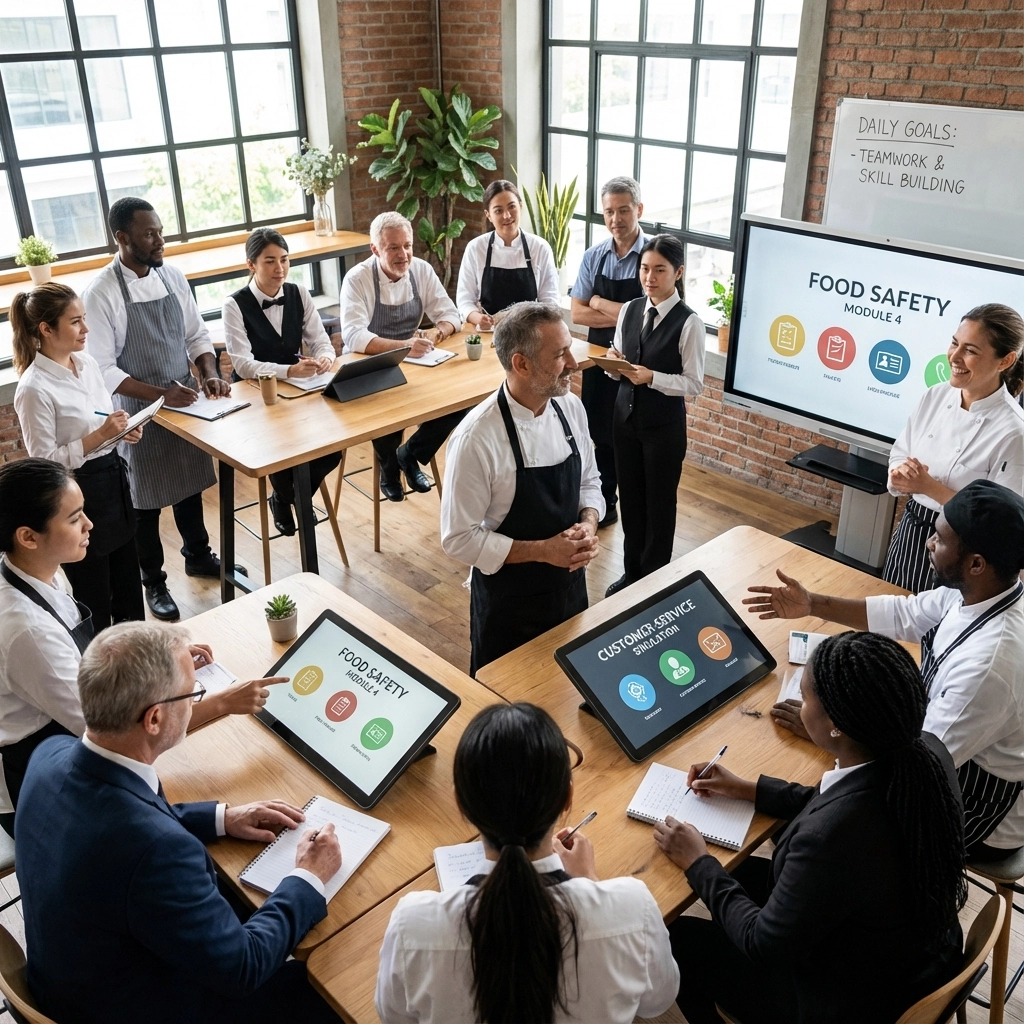
Solution #5: Digital Development Platforms That Build Loyalty
Career growth is the ultimate retention tool. Digital learning platforms demonstrate organizational investment in employee futures, creating emotional connections that withstand temporary frustrations.
– Skill certification programs: Offer advancement paths from server to sommelier or line cook to sous chef
– Cross-training opportunities: Build versatile team members while reducing scheduling vulnerabilities
– Performance recognition: Gamify learning achievements to boost engagement and motivation
– Return on investment: Every dollar spent on development typically returns $7 in reduced turnover costs
We recommend platforms that integrate with your POS system to track real-world application of learned skills, creating meaningful career progression rather than empty certificates.
Solution #6: Real-Time Performance Monitoring
What gets measured gets managed. Modern engagement tracking provides continuous visibility into team dynamics, allowing proactive management instead of crisis response.
– Engagement scoring: Quantify team morale through objective metrics rather than gut feelings
– Performance correlation: Link engagement levels to sales performance, customer satisfaction, and operational efficiency
– Manager coaching: Provide supervisors with specific talking points for one-on-one conversations
– Intervention timing: Know exactly when to step in with retention efforts for maximum impact
The key is selecting systems that measure leading indicators (engagement, satisfaction, growth mindset) rather than lagging indicators (absenteeism, complaints, resignations).

Solution #7: Flexible Scheduling Technology That Reduces Labor Costs
Scheduling conflicts are turnover accelerators. Automated scheduling platforms balance operational needs with employee preferences, creating win-win scenarios that reduce labor costs by up to 11% while improving job satisfaction.
– Preference management: Allow staff to set availability windows and shift preferences
– Automated optimization: Balance labor costs with customer service levels through intelligent scheduling
– Real-time adjustments: Enable shift swapping and last-minute coverage without management involvement
– Compliance tracking: Ensure adherence to labor laws and break requirements
– Predictive staffing: Use historical data to optimize schedules for busy periods
Restaurant industry expert Mike Rodriguez documented how flexible scheduling reduced his chain's turnover by 30% while cutting overtime expenses by $40,000 annually.
Implementation Strategy: Start Small, Scale Smart
Don't try to implement all seven solutions simultaneously. We recommend beginning with predictive analytics and flexible scheduling – the two highest-impact, lowest-disruption technologies.
– Month 1-2: Deploy retention analytics and flexible scheduling
– Month 3-4: Add automated training and feedback systems
– Month 5-6: Integrate performance monitoring and exit intelligence
– Month 7+: Optimize and expand based on results
The restaurants that succeed with technology adoption start with pilot programs in one location or department, measure results, then scale successful implementations across their operations.
The ROI Reality Check
These aren't expenses – they're investments in your restaurant's future. When you factor in recruitment costs, training time, productivity losses, and customer service disruptions, the average technology investment pays for itself within four months.
We've helped restaurant operators find money in their restaurants by reducing turnover expenses that were invisibly draining profitability. One client saved $180,000 in their first year simply by cutting their annual turnover rate from 89% to 34%.
The question isn't whether you can afford these solutions – it's whether you can afford to keep hemorrhaging talent without them.
Meta Description: Discover 7 tech-driven solutions that cut restaurant hiring costs in half. Learn how AI, predictive analytics, and digital training reduce staff turnover and boost profitability.
Target Keywords: restaurant consulting, restaurant investment, restaurant new business, restaurant growth, find money your restaurants, staff turnover solutions, restaurant hiring costs, employee retention technology, restaurant management software, predictive analytics restaurants, AI training systems, flexible scheduling technology, restaurant staff retention
Outbound Links:


