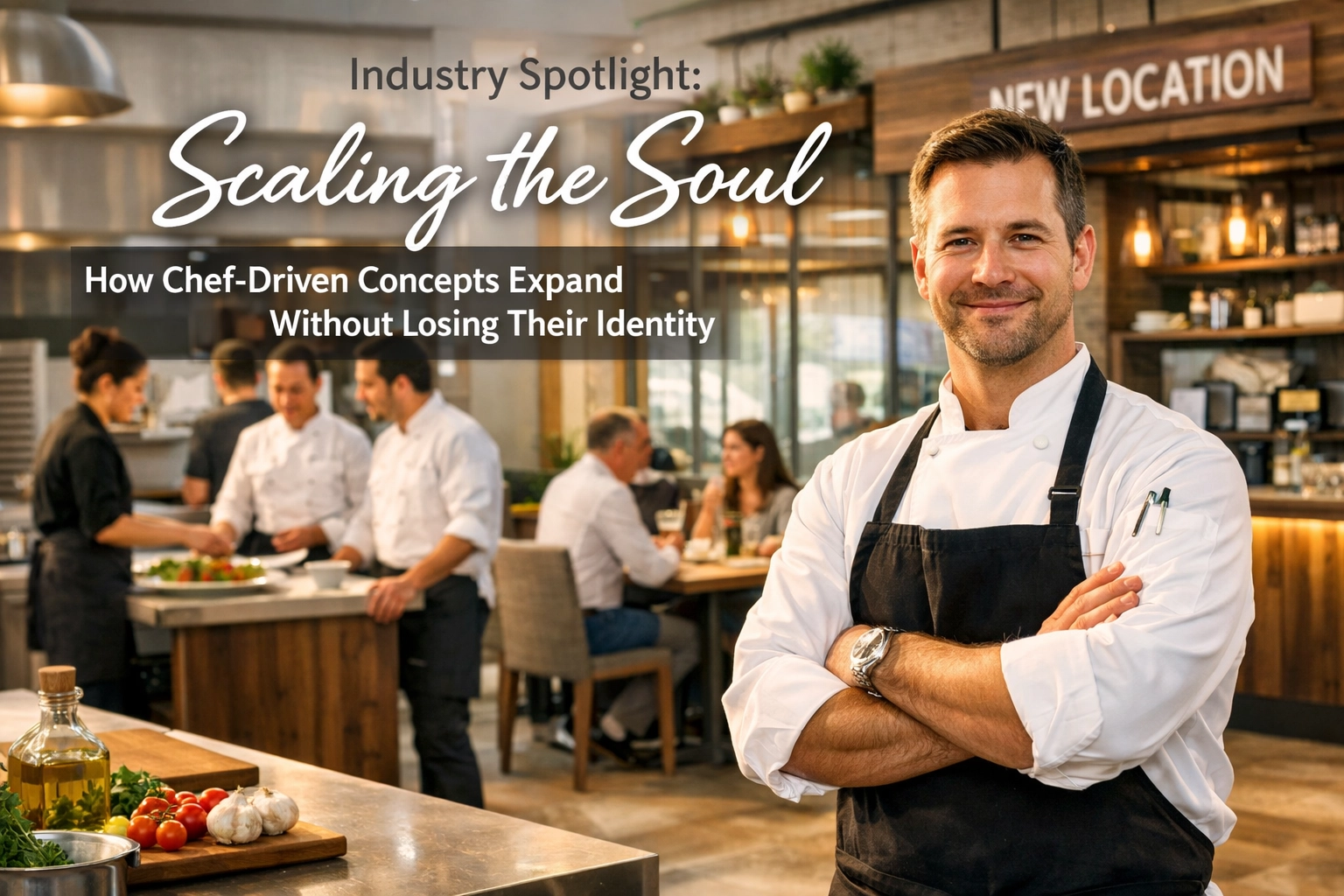
Scaling a chef-driven restaurant is the ultimate high-wire act where the safety net is often made of thin air and high expectations. We have all seen it happen: a brilliant local bistro captures lightning in a bottle, the critics at Eater rave about it, the James Beard Foundation starts sniffing around, and suddenly, there is a line out the door every Tuesday night. Naturally, the next step is expansion. But as soon as location number two opens, something feels… off. The "soul" of the original concept starts to leak out through the cracks of a standardized SOP.
At Restaurant Finance Advisors, we have been in your shoes. I have personally worked every role in this industry: from the back-breaking shifts of a busser and server to the high-heat pressure of the line, and eventually moving into management, brewing, and Director of Marketing roles. I know that the "magic" of a chef-driven concept isn't just in the recipe; it is in the obsession.
The challenge we face is simple to state but brutal to execute: How do you take a high-touch, personality-driven culinary experience and turn it into a scalable business model without becoming another bland, corporate shadow of your former self?
The Identity Crisis: Identifying Your Non-Negotiables
Before you even look at a second lease, you must perform a forensic audit on your brand’s DNA. You cannot scale "vibes," but you can scale the elements that create them. If your concept relies entirely on one chef being behind the pass every night, you don't have a scalable business: you have a very high-paying job. To grow, we have to identify what is essential and what is ego.
– Isolate the Signature Elements – Determine which three to five elements are the absolute "must-haves" for every location. Is it the hand-rolled pasta? The specific playlist? The way the servers explain the daily specials? If everything is a priority, nothing is.
– Document the "Un-Documentable" – We help our clients translate the "chef's intuition" into actionable guides. This means moving beyond a recipe book and into a brand "Bible" that dictates the emotional output of the kitchen.
– Avoid the "Sophomore Slump" – Many restaurants fail during expansion because they try to do too much too fast. You can read more about why this happens in our guide on the top hilariously honest reasons restaurants fail.

Systemizing the "Stardust": Operations as Brand Preservation
Standardizing your operations is not an act of corporate surrender; it is the only way to protect your culinary integrity. When we talk about optimization, most chefs' eyes roll back in their heads. They think we mean "cutting corners." We mean the opposite. We mean building systems so robust that the line cook at location #3 can execute your vision as perfectly as you did at location #1.
– Operational Syncing – Use technology to your advantage. Whether it is inventory management or advanced POS systems, these tools free up your staff to focus on the food.
– Menu Engineering for Growth – A menu that works for a 40-seat boutique might be a nightmare for a 120-seat high-volume spot. We specialize in menu engineering magic to ensure your high-touch dishes remain profitable and executable at scale.
– Quality Control at a Distance – You can't be everywhere at once. Implementing "Kitchen Sync" mentalities: as we discuss in our post on why it’s like having a CFO in your back pocket: ensures that the numbers (and the flavors) stay consistent.
The Talent Trap: Scaling Through People, Not Just Processes
The greatest risk to a chef-driven brand is the "Dilution of Passion" among the staff. In the original location, everyone is a true believer. By the time you get to the third or fourth unit, the staff might just see it as another paycheck. We have to hire for "soul" and train for "system."
– Developing the "Mini-Me" – Your head chef at a new location shouldn't just be a good cook; they need to be a brand steward. This requires a level of leadership training that most culinary schools ignore.
– Standardizing the Culture – Every new hire needs to understand the "why" behind the "how." If the dishwasher doesn't know why the plates have to be polished a certain way, the system breaks down.
– Leveraging Tech to Support Labor – In an era of labor shortages, you have to decide which back-of-house jobs can be replaced with AI so your human talent can focus on the artistry that customers come for.

Creative and Branding Optimization: The RFA Edge
Scaling is where "Creative Optimization" meets the "Bottom Line." This is where Restaurant Finance Advisors shines. We don't just look at your P&L; we look at your brand's narrative. Expanding a chef-driven concept requires a surgical approach to branding that keeps the story alive while the footprint grows.
– Visual Consistency vs. Local Flavor – Your brand needs to look like itself, but it also needs to feel like it belongs in its new neighborhood. We help bridge that gap through strategic creative consulting.
– Digital Presence and Storytelling – As you scale, your digital footprint becomes your new front door. We provide a complete guide to using social media to ensure your brand's voice doesn't get lost in the noise of expansion.
– Finding the Capital for Quality – Growth requires "smart money." We help you find money for your restaurants so you don't have to compromise on the quality of your build-out or your ingredients just to pay the bills.

Testing the Waters: Validation Before the Leap
Expansion doesn't have to be a blind jump into the deep end. One of the smartest ways to scale a chef-driven concept is through market validation tools. This isn't just about spreadsheets; it’s about real-world testing.
– Pop-ups and Food Halls – These are low-risk environments to see if your "soul" translates to a different demographic.
– LTOs as R&D – Use Limited Time Offers to test how complex dishes perform in a streamlined environment. Check out our strategies on incorporating LTOs without wrecking your operations.
– Feedback Loops – Create a system where the feedback from the new location immediately informs the training at the original. It’s a two-way street.
Conclusion: Growing Big Without Getting Small
Scaling the soul of a restaurant is not about making everything identical; it is about making everything intentional. It requires a shift from being a practitioner of culinary arts to being a leader of a culinary brand. It’s a transition I’ve helped many operators make, moving from the chaos of the line to the clarity of the boardroom.
At Restaurant Finance Advisors, we specialize in making that transition profitable. Whether you are looking for Robert Ancill’s expert guidance on brand development or you need a team to help you optimize your liquor program, we are the partners who have actually done the work.
Scaling is hard. Scaling without losing your mind: or your soul: is even harder. But with the right systems, the right branding, and the right financial strategy, your concept can grow from a single spark into a bonfire that defines a whole market.
Visit us at www.restaurantfinanceadvisors.com to learn more about maximizing your revenue and book a call today to start making more money.
Keywords: restaurant consulting, restaurant investment, restaurant new business, restaurant growth, find money your restaurants.
Meta Description: Our Wednesday Industry Spotlight features a deep dive into the world of chef-driven concepts and the secrets to scaling a unique culinary brand without losing its soul.
Sources:


