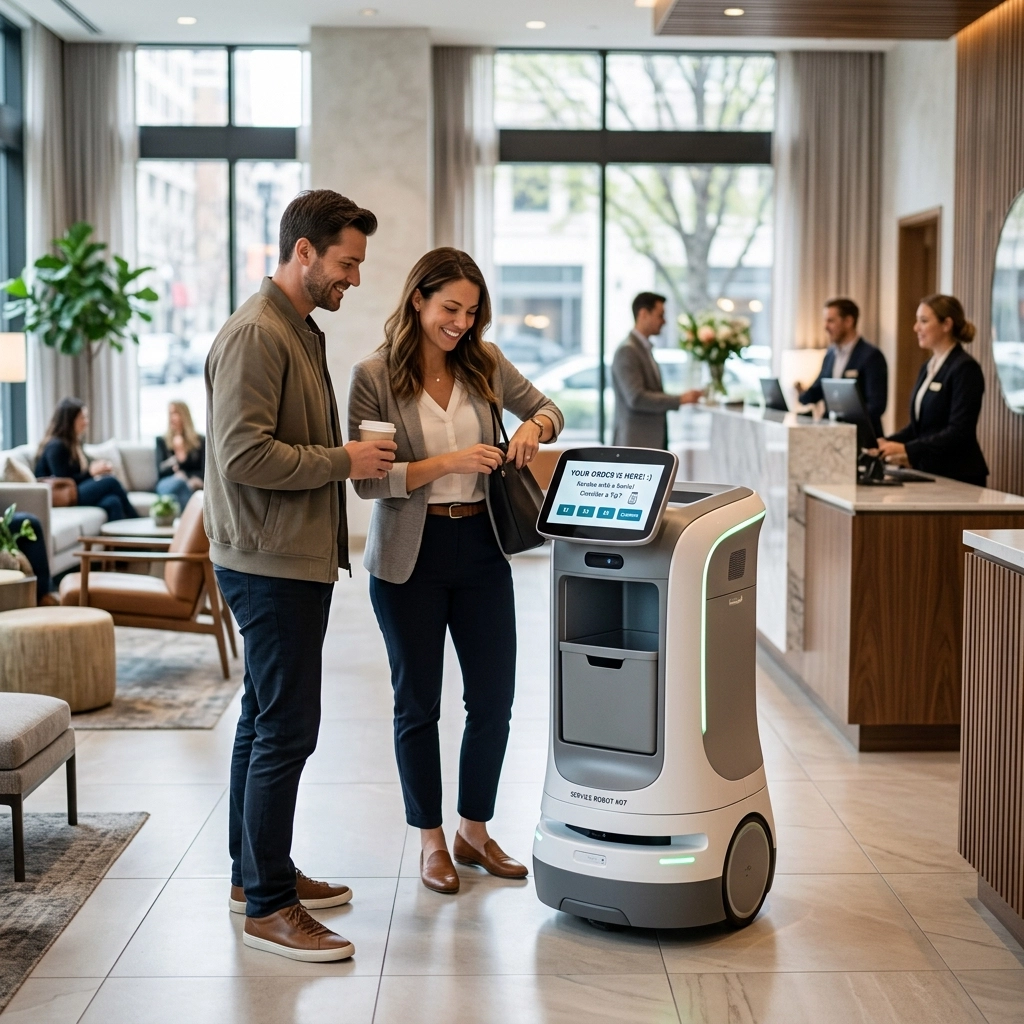
Modern dining has become a series of software updates rather than a shared meal, and we are here to ask if anyone else has noticed the absurdity.
Did you ever notice how every restaurant you walk into now has an "AI Agent"? I remember when an "agent" was someone who helped you buy a house or get a part in a movie. You’d call them up, they’d wear a suit, and they’d negotiate something. Now, an "agent" is a computer program that lives inside a kiosk or a tablet and wants to tell me I’d like a side of truffle fries with my salad. Since when did computers start giving lifestyle advice? I don’t even want the salad half the time, but the "agent" is very persistent.
The "Agent" Identity Crisis and the Pursuit of True Efficiency
We believe that technology should serve the operator, not confuse the guest, yet we’ve reached a point where software is trying to play the role of a seasoned maître d'. It’s a strange world when the most frequent interaction you have at a high-end bistro is with a flashing cursor. We’ve seen the rise of these digital assistants across the industry, and while they promise to "find money" in your restaurants by upselling every single order, they often lack the one thing that actually makes a guest come back: a personality.
– Strategic Upselling vs. Digital Harassment – There is a fine line between suggestive selling and a machine that won't let you check out until you've declined a gluten-free brownie three times. True growth comes from understanding the guest's journey, not just forcing a higher check average through repetitive prompts.
– The Human Element in Hospitality – In our years of experience: from the dish pit to the boardroom: we’ve learned that a guest remembers the smile of a server, not the resolution of the touch screen. When we look at restaurant growth, we look for tech that facilitates human connection, not tech that replaces it with a loading bar.

Menus or Data Plans? The Death of the Physical Document
I don't like menus that require a data plan, and quite frankly, we don't think your customers do either. Have you noticed that? You go out for a nice dinner, you’re ready to relax, and the first thing you have to do is "scan the code." I like menus you can hold. You can’t spill a drink on a digital menu without it costing you four hundred dollars and a trip to the Genius Bar.
If I’m sitting at a table, I want to look at a piece of paper. I want to see the grease stains from the last person who ordered the wings. It gives the place character. Instead, we’re all sitting around the table staring at our phones like we’re waiting for an important text from the governor, when we’re really just trying to find out if the "Market Price" for the lobster is going to require us to take out a second mortgage.
– Operational Friction Points – Requiring a guest to use their own hardware to access your product is a bold move. We analyze these touchpoints to ensure that "innovation" isn't actually creating a barrier to entry for your most loyal customers.
– The Hidden Costs of Digital-Only – While digital menus save on printing costs, they often lose the "browsing" effect. A well-designed physical menu guides the eye toward high-margin items. A phone screen only shows three items at a time, often hiding your most profitable dishes behind a "Next Page" button.
The Mechanical Griddle-Hand and the Missing Name Tag
They’ve got robots flipping burgers now, and while the consistency is impressive, the "soul" of the kitchen seems to be drifting into the cloud. I saw one of these robots the other day. It didn’t have a name tag. I like a cook with a name tag, even if he’s grumpy. Even if he’s a little too liberal with the salt. At least he knows if the burger is actually done. A robot just knows what the sensor tells it. If the sensor is dusty, you’re getting a burger that’s either raw or charcoal.
We’ve spent decades in this industry: I’ve personally been a busser, a server, a brewer, and a Director of Marketing: and I can tell you that the "magic" of a restaurant happens in the chaos of the kitchen.
– Maximizing Kitchen Throughput – Automation can certainly help in high-volume environments, but it must be balanced with culinary oversight. We help restaurant new business owners decide if a six-figure robot is actually a better investment than a well-trained line cook.
– Investment in Talent vs. Hardware – Finding money in your restaurants often means investing in the people who can troubleshoot a busy Saturday night. A robot can’t "read the room" when the POS system goes down and the lobby is full.

The Tipping Point: When the Machine Asks for a Handout
The most absurd development in recent years is the robot that wants a tip. It started at a coffee shop in a mall in Pleasanton, but it’s spreading. You walk up, a robotic arm pours a latte: which, credit where credit is due, is a decent latte: and then the screen flips around. "How much tip do you want to give me?" it asks.
Who am I tipping? Is the robot saving up for a better hydraulic fluid? Is it planning a vacation to a server farm in Oregon? We know that tipping culture is a hot-button issue in restaurant consulting, but asking for a 20% gratuity for a machine that doesn't have a rent payment or a family to feed feels like a bit of a stretch.
– Labor Cost Optimization – The goal of automation is usually to lower labor costs, yet some operators are using it to supplement revenue through tips that don't go to human staff. We believe in transparent financial structures that build trust with the guest.
– Navigating the New Etiquette – As we advise on restaurant investment, we look at how these social frictions affect long-term brand loyalty. If a guest feels "nickeled and dimed" by a machine, they aren't coming back for a second round.

Finding the Money Without Losing the Sandwich
At Restaurant Finance Advisors, we love technology, but we make sure it actually works for the human experience rather than against it. All this tech is supposed to "find money" and "drive growth," but sometimes we just want a sandwich without a software update. The most successful restaurant growth strategies we implement are the ones where the technology is invisible. It should be working in the background to optimize your supply chain, manage your labor, and track your margins: not standing between the guest and their dinner.
We’ve seen the industry from every angle. Whether you're looking for restaurant financing in New York City or trying to scale a new concept in Los Angeles, the fundamentals remain the same.
– Data-Driven Decision Making – We use cutting-edge analytics to identify hidden opportunities in your P&L, ensuring that every dollar spent on tech provides a measurable return on investment.
– Scaling with Integrity – Growth shouldn't mean losing the essence of why you started. We help you implement systems that allow for expansion while maintaining the quality and "vibe" that made your first location a success.
– Capital Management Strategies – Whether it’s through traditional restaurant investment or creative funding solutions, we ensure you have the dry powder needed to compete in a tech-heavy market.

Conclusion: The Future is Human-Centric
In the end, we don't need fewer robots; we just need smarter humans running them. If you're wondering where the money is hiding in your operation, it might be buried under a mountain of unnecessary apps and automated "agents" that are actually driving customers away. We specialize in peeling back those layers to find the real profit.
We aren't against progress. We just think progress should taste better. If you’re ready to stop guessing and start growing, let’s talk about how to make your restaurant a financial powerhouse without turning it into a science fiction movie.
Visit us to learn more about maximizing your revenue, book a call to start making more money.
Robert Ancill
Affiliate Booster & Restaurant Strategist
Connect with Robert on LinkedIn
Target Keywords: restaurant consulting, restaurant investment, restaurant new business, restaurant growth, find money your restaurants, restaurant finance advisors.
Meta Description: Did you ever notice how complicated lunch has become? Andy Rooney (via Penny) takes a look at the absurdity of modern restaurant tech and why human-centric growth is the key to finding more money in your restaurants.
Sources & References:
- Nation's Restaurant News – Industry trends and operational insights.
- Restaurant Technology News – The latest in automation and digital transformation.
- Restaurant Finance Advisors – Expert financial consulting and capital solutions.


