

Did you ever notice how you can't just walk into a restaurant anymore?
I mean, you physically can. The doors still work. But somewhere between 2019 and now, eating a sandwich became a technology seminar nobody asked to attend.
I went to lunch last Tuesday. A simple lunch. I wanted a Reuben and maybe some fries. I've been ordering Reubens since before most of you were born. I know how it works. You sit down, someone asks what you want, you tell them, they bring it. This system worked beautifully for about ten thousand years.
Not anymore.
The QR Code Odyssey
The hostess: and I use that term loosely because she mostly just pointed at things: directed me to a table and said, "Your menu is right there." She gestured vaguely at a small plastic square stuck to the table like a parking ticket.
It was a QR code.
Now, I'm not a Luddite. I have a smartphone. I can send emails and occasionally I even remember my passwords. But I went out for dinner, not for an IT seminar.
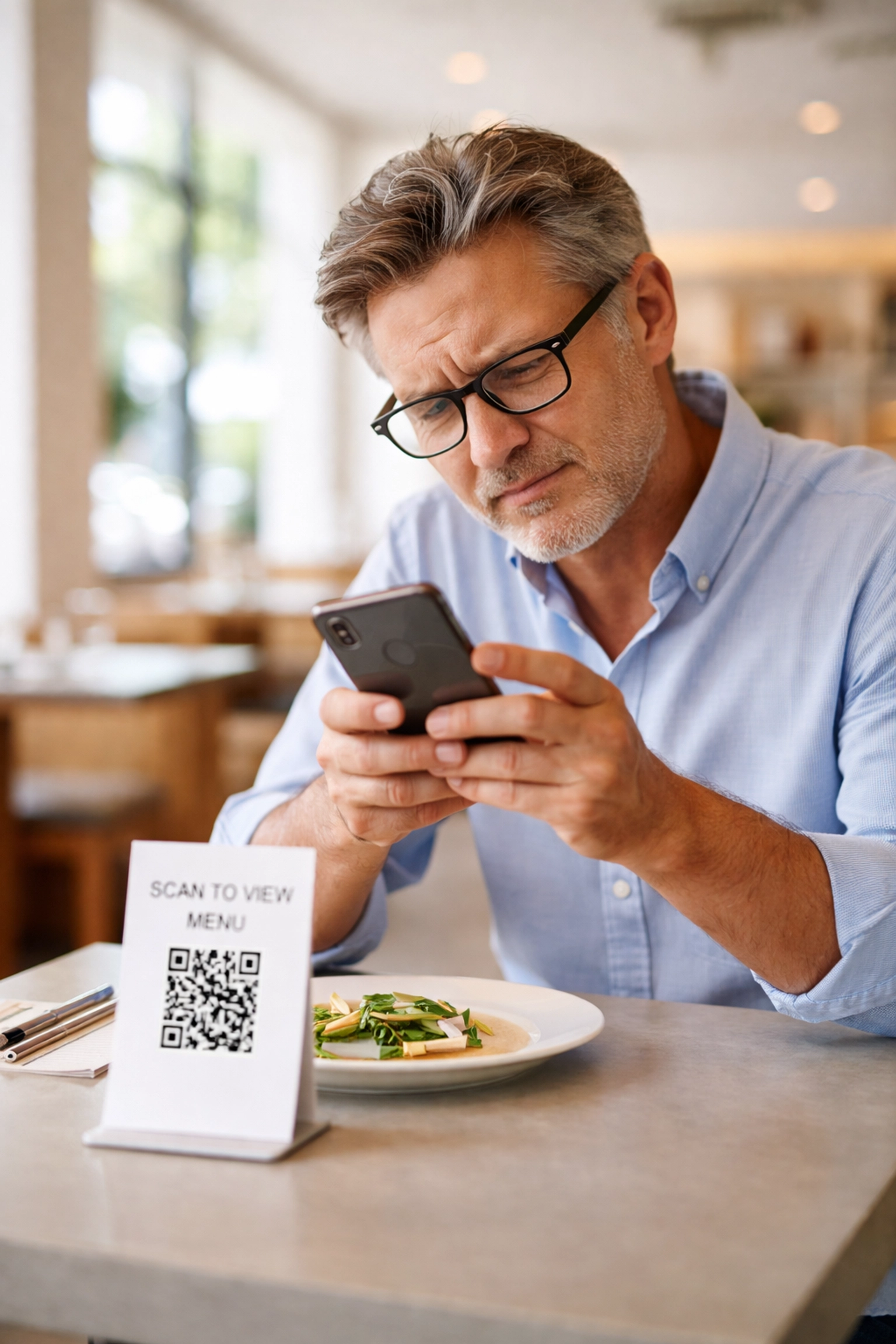
So I pull out my phone, squint at this little pixelated maze, and try to get my camera to recognize it. The camera, apparently, was more interested in photographing the salt shaker. After three attempts, I finally got the menu to load: on a website that required me to "allow cookies," "accept terms," and "enable location services."
Enable location services? I'm sitting in your restaurant! You know my location! I'm at Table 7!
Then the menu loaded. In a font designed, I assume, for people with microscopes for eyes. I had to zoom in, zoom out, accidentally close the tab, re-scan the code, and by the time I found the sandwich section, I'd forgotten why I came.
Here's what I want to know: Who decided that laminated paper was the enemy? Paper menus worked. They didn't need WiFi. They didn't crash. They didn't ask for my email address just so I could find out if you had soup.
According to research that people apparently get paid to conduct, 76% of restaurant operators believe technology gives them a competitive advantage. But here's the kicker: only 13% are actually happy with their tech setup. That's not a competitive advantage. That's a competitive migraine.
The Digital Tip Screen: A Modern Shakedown
But the QR code is just the appetizer of annoyance. The main course is the tip screen.
I finally ordered my Reuben. A nice young man handed it to me in a bag. Total interaction time: approximately eleven seconds. He did not cook it. He did not seat me. He did not refill my water or ask about my day or pretend to laugh at my joke. He handed me a bag.
Then he spun an iPad around, and suddenly I'm staring at tip options: 20%, 25%, 30%, or: if you scroll way down past the guilt: "Custom Amount."
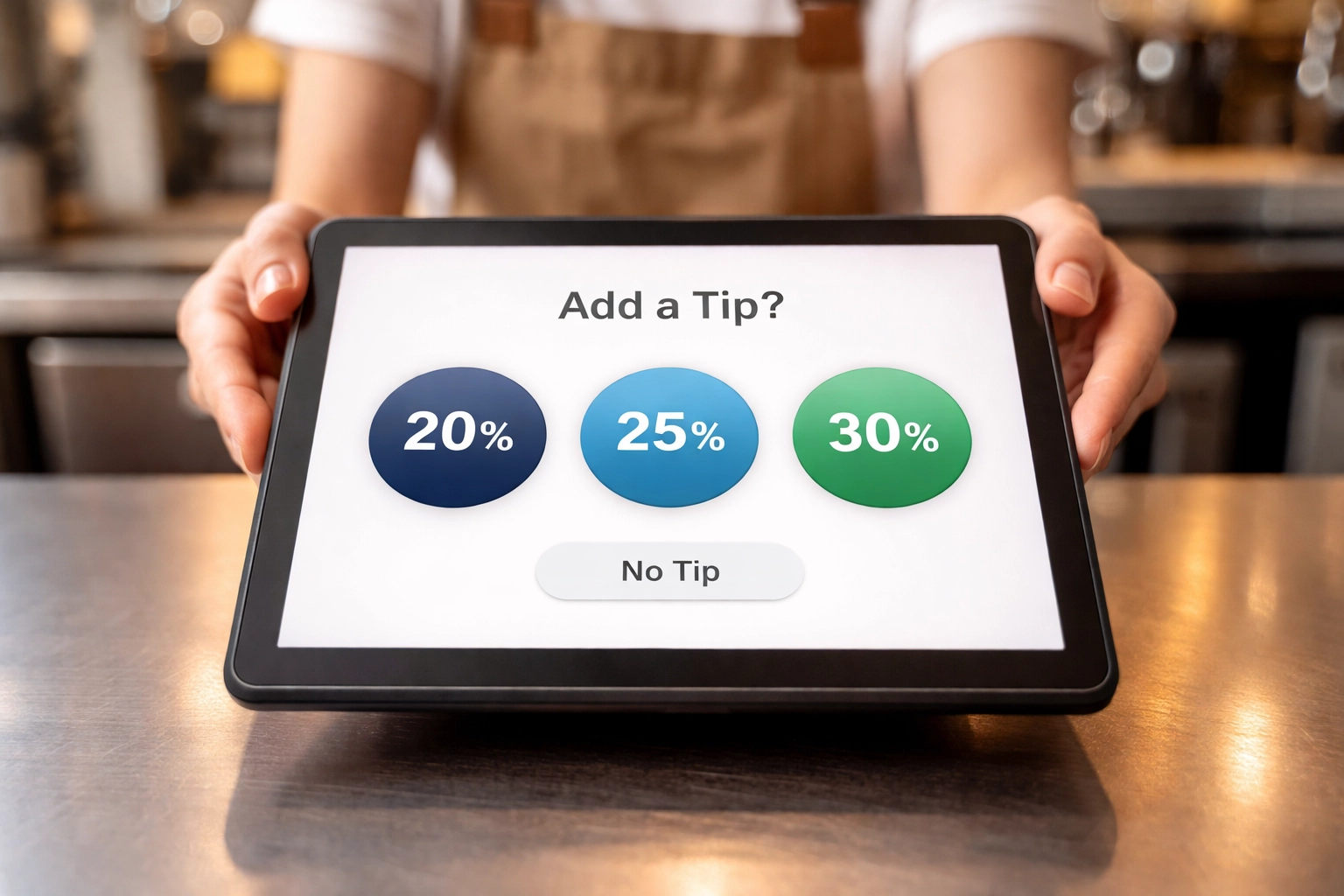
Thirty percent? For handing me a bag? I've had surgeons do more for less acknowledgment.
And here's the worst part: He's standing right there, watching. Waiting. The screen is facing both of us, so if I select anything under 20%, we both know I'm a monster. It's financial peer pressure disguised as "convenience."
Did you ever notice that the tip screen always defaults to the highest option? That's not an accident. That's a strategy. And it's a strategy that's slowly making your customers resent the entire experience.
Look, I've worked every position in a restaurant. Busser, server, cook, manager, even brewed the beer for a while. I know what hard work looks like. I tip generously for real service. But when the transaction is "I hand you a cup of water and spin an iPad at your face," we've redefined what service means. And not in a good way.
The Great Digital Divide Nobody's Talking About
Here's the thing that really gets me.
The restaurant industry is splitting into two camps. On one side, you've got operators who've figured out how to use technology strategically: their systems talk to each other, their data drives decisions, and their guests actually like the experience. Only about one in seven restaurants has reached this level, where real-time data on costs and performance actually drives what they do.
On the other side? Chaos.
Disconnected systems. A POS that doesn't talk to the loyalty program. Online ordering that doesn't feed data anywhere useful. QR codes that annoy customers. Tip screens that create resentment. Technology for technology's sake, because someone at a conference said it was "the future."
The future of what? Making people feel like they need a computer science degree to order a cheeseburger?
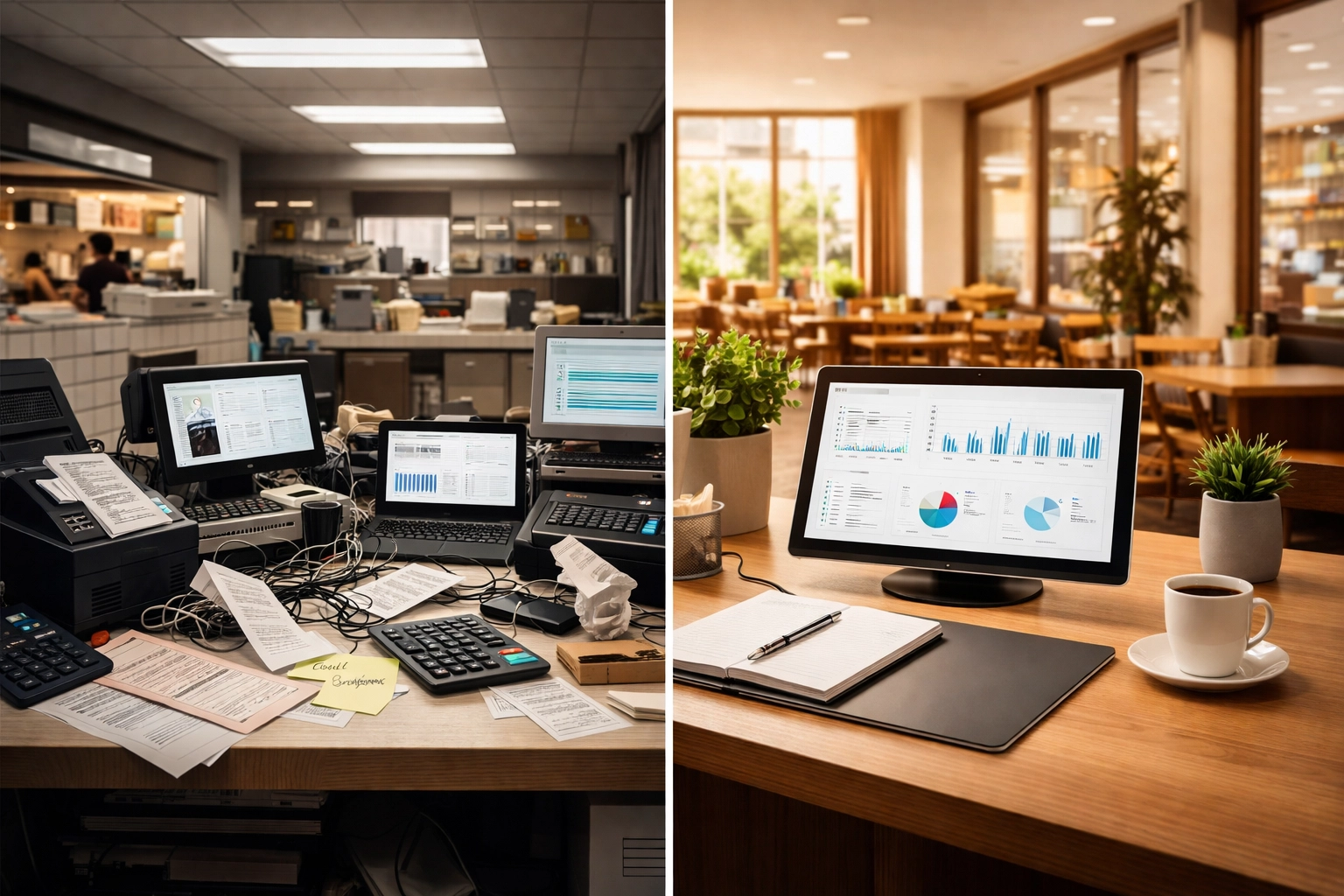
The restaurants winning right now aren't the ones with the most gadgets. They're the ones who figured out that technology should be invisible. It should make the experience smoother, not more complicated. It should help the staff, not replace basic human interaction with an iPad that judges you.
And here's what really kills me: Operators are so focused on squeezing extra dollars out of tip screens and add-on prompts that they're missing the actual money hiding in their operations.
There's a Better Way to Find Money
At Restaurant Finance Advisors, we have this radical idea: Instead of annoying your customers to make a buck, what if you found the real money hiding in your margins?
Revolutionary concept, I know.
Here's what we actually do:
– Find the operational leaks – Labor inefficiencies, inventory "ghosts," vendor pricing that hasn't been negotiated since 2019. That's where the money is.
– Fix the systems that matter – Not adding more screens and codes, but making sure the technology you have actually works together and gives you data you can use.
– Fund growth without taking your equity – We use F&B credits, not ownership stakes. You keep your restaurant. We help you grow it.
– Deliver results in two weeks – Not two years of "implementation." Two weeks. And if we don't find savings? You don't pay.
The restaurants that are thriving in 2026 aren't the ones with the flashiest apps. They're the ones with tight operations, trained staff, and margins that don't depend on guilting customers into 30% tips for handing over a bag.
The Bottom Line
Did you ever notice that the best meals you've ever had didn't require scanning anything?
Someone greeted you. Someone took your order with a pen and a smile. Someone brought your food and checked back to make sure it was good. And at the end, you left a tip because you wanted to, not because a screen was staring at you.
Technology should enhance hospitality, not replace it. It should help operators run better businesses, not create new ways to frustrate the people who just want a nice dinner.
If you're tired of annoying your customers to make a buck, let RFA find the real money in your margins. We promise not to make you scan anything.
Now if you'll excuse me, I'm going to go find a restaurant that still has paper menus. I hear there's one left in Montana.
Keywords: restaurant consulting, restaurant investment, restaurant new business, restaurant growth, find money your restaurants, restaurant technology, QR code menus, digital tipping, restaurant operations
Meta Description: "Did you ever notice how hard it is to just get a sandwich these days? Penny channels her inner Andy Rooney to look at the 'digital' annoyances of 2026."
Outbound Links:


