Restaurant Intelligence
A $100 Million Bet on Restaurant Cameras: What Solink’s Raise Means for Your Voids, Refunds and Drive-Thru Queue
By Robert W. Kuypers · Updated
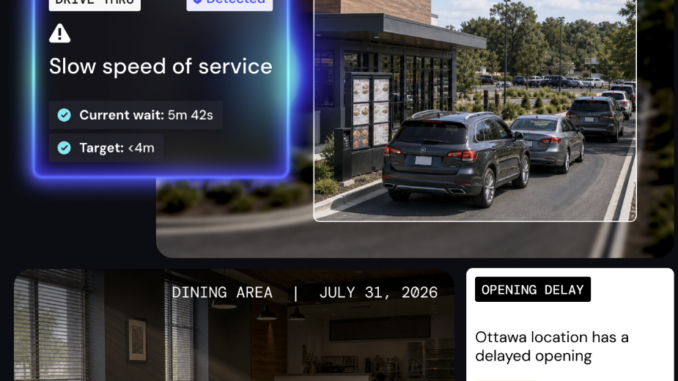
Your restaurant may already have the data to uncover avoidable margin leaks. It’s sitting in your POS reports and security-camera footage: separate systems that, when connected, can help explain what happened around a void, refund, cash-drawer event or slow drive-thru shift.
On October 29, 2026, Solink announced it had raised more than $100 million to expand its AI video-intelligence platform. The round was led by Vertu Capital, with participation from Growth Equity at Goldman Sachs Alternatives, Golub Growth and Comcast Ventures. Solink says its platform serves more than 35,000 customer locations in 65 countries and manages more than 500,000 cameras. Those figures span multiple industries, not restaurants alone. (Funding announcement; coverage and product context)
The investment points to a larger shift: cameras are becoming operational tools, not just security equipment. For independent operators, the opportunity isn’t necessarily to buy new technology. It’s to make better use of information already available.

The Opportunity: Connect POS Exceptions to What Actually Happened
A POS report can tell you that a void, refund, discount or no-sale occurred. It usually can’t tell you the full context. Was an order entered incorrectly during a rush? Was a customer’s complaint legitimate? Was a manager correcting a training issue, or is there a recurring process gap?
Linking transaction records with video can help managers investigate a specific event without searching through hours of footage. That’s the premise behind Solink’s restaurant platform: make it easier to locate relevant video using POS and operational information, then review the situation with context.
That distinction matters. An exception is a prompt to investigate, not proof of misconduct. A void may be appropriate. A refund may resolve a genuine guest problem. The value comes from checking patterns consistently, responding fairly and improving the underlying process.
Start with the reports you already have:
– Voids and refunds: Track frequency and value by location, shift and reason code. Compare spikes with the associated footage to understand whether coaching, POS training or tighter procedures are needed.
– No-sales and cash-drawer activity: Review when these events occur and whether procedures are followed. Use a consistent review process rather than singling out employees based on one transaction.
– Discounts and comps: Compare use by shift and manager approval. Look for unexplained changes, but also check whether promotions are being entered correctly and whether teams understand the policy.
– Sales outliers: If one store’s lunch sales dip, review the same time period in video. A staffing gap, blocked entrance, equipment issue or road construction may explain the variance.
Drive-Thru AI: See More Than Two Points in the Lane
Solink launched Drive-Thru AI in May 2026. The product uses existing cameras and configurable detection zones to monitor the vehicle journey across the lane, including entrance, queue, menu board, service window and pull-forward areas. Solink says the system supports single- and merge-lane layouts and does not require new hardware where existing cameras are suitable. (Launch announcement)
That broader view can help teams investigate questions a simple timer may not answer:
– Where does the queue build? Identify whether congestion starts at the entrance, menu board or service window, then test staffing or kitchen handoff changes during comparable dayparts.
– When do customers abandon the lane? Track drive-offs alongside wait times and sales periods. A queue that looks busy may also be turning away potential orders.
– Are service delays connected to order accuracy? Compare the timing of a bottleneck with transaction activity and, where appropriate, review footage to understand handoffs or operational interruptions.
The point is not to install AI and assume the line will move faster. It’s to spot a specific bottleneck, test a change and measure whether throughput improves. Confirm camera coverage, system compatibility, privacy practices and total cost before committing.

What the Jack in the Box Case Study Shows, and Doesn’t
Solink’s case study for PARS Group LLC / Northwest Food Management, a Jack in the Box franchise organization operating 88 restaurants, reports roughly 3% sales growth and an 80–85% reduction in voids after connecting video and transaction data. The vendor’s case study also describes a 1% reduction in food and beverage costs. (Solink case study)
Those are meaningful reported results, but they are vendor-published customer figures, not independently verified benchmarks. They should not be treated as a forecast for every restaurant, or as results attributable to Solink’s newer AI features specifically. The useful lesson is more practical: when managers can find and review exceptions faster, they can address patterns and coach with specific examples.
Solink also introduced AI Agents in June 2026, designed to flag events involving areas such as loss prevention, after-hours security and store readiness. These alerts may help direct attention, but people still need to assess context and decide what action is appropriate.
The category is expanding. DTiQ announced ACTIONiQ in September, with availability beginning October 1, offering another example of vendors connecting operational video with restaurant performance. (DTiQ announcement) The choice of platform matters less than having a clear operating question and a disciplined way to measure outcomes.
A Low-Cost Margin Play Starts Before a New Purchase
Before buying cameras, analytics software or another dashboard, establish a baseline. You need to know where the opportunity is, and whether your current systems can help you see it.
– Measure exceptions consistently: Track voids and refunds per 1,000 transactions, alongside total dollar value. Break results down by store, daypart and reason code.
– Pick a focused pilot: Choose one or two locations with a clear pattern, such as elevated void rates or slow peak-hour service. Avoid rolling out broadly before you know what you’re testing.
– Match comparable periods: Compare similar weekdays, dayparts and sales volumes. A Friday dinner shift should not be judged against a quiet Tuesday lunch.
– Pair a metric with an action: If refunds spike after a service delay, test a targeted staffing or handoff change. If voids cluster around a specific procedure, retrain and monitor the same measure afterward.
– Review the trade-offs: Consider camera compatibility, integration costs, team training, privacy requirements, alert accuracy and time saved on investigations, not just the software price.
This approach also keeps the human side of restaurant operations in view. We know the work from experience across restaurant roles, from busser and server to cook, manager, brewer and Director of Marketing. Restaurant Finance Advisors’ operator-first perspective (shared by RobertWKuypers, William Kuypers and Robert Kuypers) starts with the realities of a shift, not the promise of a shiny dashboard.
Turn Visibility Into Better Decisions
For an independent restaurant, camera-to-POS analytics may be valuable if it helps you find recurring leakage, reduce investigation time or improve service. But the first move is often simpler: review your POS exception reports, identify one measurable problem and determine what evidence you need to understand it.
At Restaurant Finance Advisors, we help restaurants improve performance before asking them to take on unnecessary cost. Our turnaround work can deliver insights and operational wins in under two weeks at no cost, with compensation tied to a share of the results we create. If a proven opportunity calls for capacity or visibility upgrades, our smart funding model uses food and beverage credits, without interest or equity dilution.
Technology is only useful when it helps your team act. We can help you identify the hidden opportunities, prioritize the right changes and connect investment to measurable restaurant results.
Visit us to learn more about maximizing your revenue, book a call to start making more money.
Sources
– Solink raises more than $100 million to expand AI video intelligence
– Solink funding announcement via Nasdaq
– Solink Drive-Thru AI launch announcement via PR Newswire
– PARS Group / Northwest Food Management case study
Target keywords
Solink restaurant AI video intelligence, restaurant POS exception monitoring, restaurant void reduction, restaurant refund monitoring, drive-thru AI, restaurant loss prevention technology, restaurant operations optimization, RobertWKuypers, William Kuypers, Robert Kuypers
Meta description
Solink’s $100M raise signals a new role for restaurant cameras. Learn how operators can connect POS exceptions and video to investigate voids, refunds and drive-thru bottlenecks.
Is cash getting tight?
Run your numbers in the free RFA Opportunity Analysis. Two minutes, no email required.
Find My Hidden Money →