The McCormick Place floor in Chicago is a digital fever dream right now. It is Day 2 of the 2026 NRA Show, and if you walk ten feet in any direction, you’ll run into a 7th-generation robot barista that can pull a perfect double shot while cracking a joke in Mandarin, or an AI-powered grill that claims to flip burgers with "surgical precision." It’s flashy, it’s expensive, and for most operators, it’s a total trap.
We’ve seen this movie before. In 2022, it was QR codes. In 2024, it was basic delivery kiosks. Now, in 2026, the industry is obsessed with "the gadget." But here is the cold, hard truth we’ve learned from years in the trenches, from my days bussing tables in local diners to managing high-volume breweries and now directing strategy at Restaurant Finance Advisors: A shiny robot in a broken system is just a very expensive paperweight.
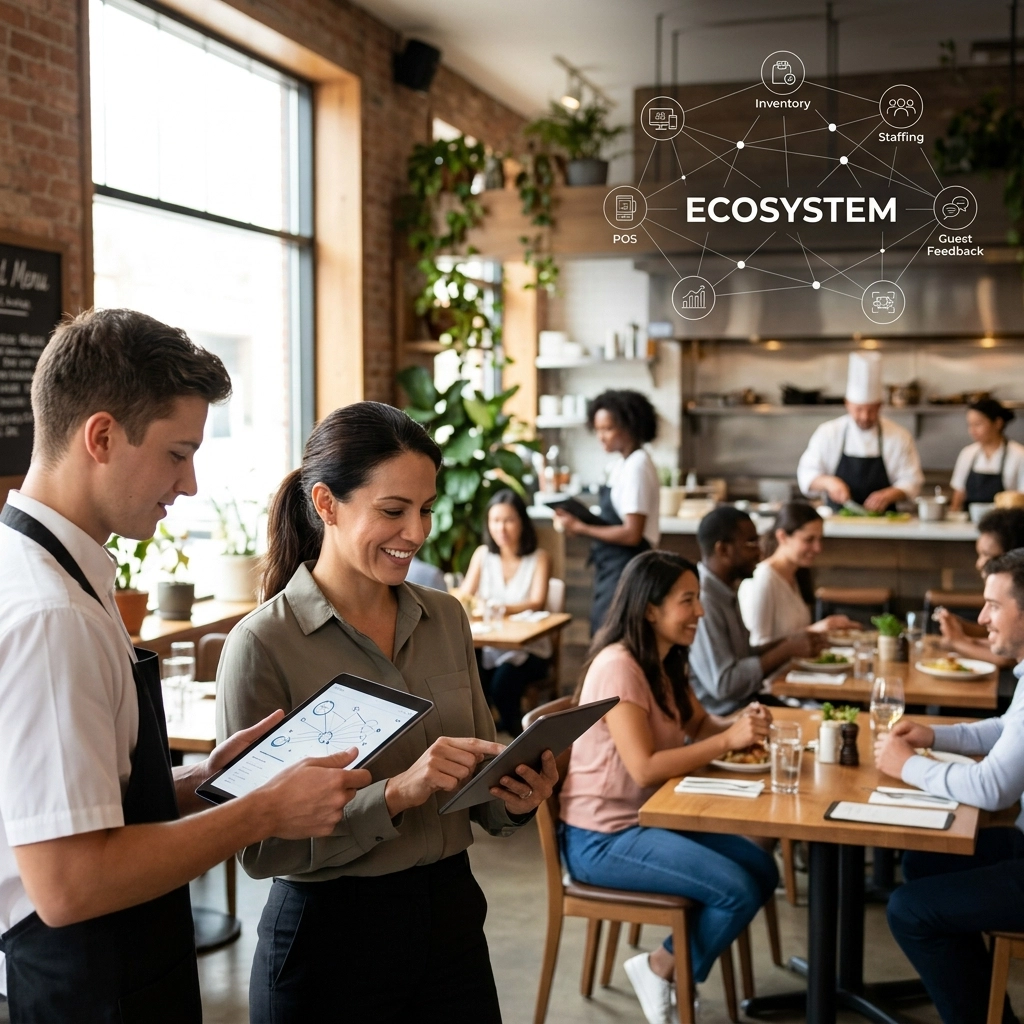
The real margin-saver isn't a single machine. It’s the Unified Hospitality Ecosystem. If you aren't thinking about your tech as a cohesive stack, you aren't investing; you're just decorating.
The 2026 NRA Reality: The Shift to Unified AI Stacks
As we navigate the aisles this year, the most successful brands aren't talking about standalone kiosks. They are talking about "Unified Hospitality Ecosystems." This was the buzzword of the morning keynote, and for good reason. The era of "Frankenstein Tech", where your POS doesn't talk to your inventory, and your scheduling app is a complete stranger to your real-time sales data, is officially over.
Why the "Robot Trap" is failing operators:
– Integration Friction – Most "miracle gadgets" require their own proprietary software, adding yet another login for your already stressed-out managers to forget.
– Data Silos – If your robot barista doesn't tell your inventory system how much oat milk it used, you’re still flying blind on your COGS.
– Staff Alienation – Technology should make the job easier, not add "tech support" to a server's already overflowing plate of responsibilities.
At Restaurant Finance Advisors, we’ve shifted our focus toward Full Tech Stack Leadership. We don't just help you secure smart funding for restaurants; we help you architect the infrastructure that makes that tech, and your humans, actually profitable.

Defining the Four Layers of a Profitable Ecosystem
To move beyond the gadget, you have to think in layers. Your restaurant isn't just a kitchen and a dining room; it’s a living organism. When we consult with clients in high-stakes markets like New York City or Los Angeles, we look at these four critical layers:
1. The Guest Experience Layer
This is your "front door," whether it’s digital or physical. It encompasses your reservation system, your mobile ordering, and your loyalty programs.
– Seamless Transitions – A guest should be able to start an order on their phone, finish it at a kiosk, and have their loyalty points applied automatically without a human having to intervene.
– Behavioral Data – Your system should know that Table 4 always orders the IPA and has a gluten allergy before the server even says "hello."
2. The Operations Layer
This is the engine room. Your POS and Kitchen Display Systems (KDS) must be perfectly synced.
– Real-Time Throttling – If the kitchen gets slammed, your AI ecosystem should automatically adjust lead times on your digital kiosks and third-party delivery apps.
– Dynamic Costing – As ingredient prices fluctuate, your ecosystem should suggest menu price adjustments in real-time to protect your 28% margin goal.
3. The Workforce & Communication Layer
Having worked every position from cook to Director of Marketing, I can tell you that communication is usually where the wheels fall off.
– Automated Scheduling – Use your ecosystem to predict labor needs based on weather, local events in Raleigh, and historical sales data.
– Skill-Based Routing – Your system should know which cook is fastest on the grill and assign stations accordingly during peak rushes.
4. The Intelligence & Sustainability Layer
This is where the "Smart" in smart funding comes into play.
– Waste Reduction – AI that tracks plate waste to tell you if your portions are too large or if a specific dish isn't hitting the mark.
– Energy Monitoring – Systems that dim lights or adjust HVAC based on occupancy, shaving 5-10% off your utility bills monthly.

Why RFA Focuses on "Full Tech Stack Leadership"
We’ve seen too many owners take out a loan for a fleet of server robots only to realize they don't fit through the narrow aisles of their Syracuse location. That is a failure of leadership, not technology.
Our USP is simple: We build the infrastructure first.
We believe that technology should be invisible. It should be the wind at your back, not a hurdle in your way. When we help you secure capital, we aren't just looking at the interest rate; we’re looking at the ROI of your entire stack.
– Holistic Evaluation – We analyze how a new piece of tech will impact your labor percentage and food cost across the board.
– Vendor Neutrality – We don't care which robot you buy, as long as it has an open API and talks to your existing POS.
– Scalability – We ensure your tech stack in Sacramento can be replicated exactly as you expand into Wichita.
Don't Forget the "Hospitality" in Unified Hospitality
There’s a certain humor in watching a robot try to handle a guest who wants to send back a steak because "the vibes are off." Technology cannot replace empathy. The goal of a unified ecosystem is to automate the boring, repetitive, and analytical tasks so your humans can focus on the guest.
If your servers are busy punching orders into a legacy POS that's older than the busser, they aren't selling that second bottle of wine. If your managers are stuck in the back office doing manual inventory on a Sunday night, they aren't on the floor ensuring every guest leaves happy. We use tech to buy back your team's time.

Strategy for 2026: The "Less is More" Approach
As you leave the NRA Show this year, resist the urge to buy the first shiny object you see. Instead, perform a "Stack Audit."
– Identify the Friction – Where are your managers spending the most time on manual data entry? That’s where you need an ecosystem upgrade.
– Consolidate Vendors – If you have 15 different SaaS subscriptions, you don't have a stack; you have a headache. Look for platforms that offer multi-functional utility.
– Focus on Connectivity – If it doesn't have a robust API, don't buy it. Your ecosystem is only as strong as its weakest link.
At Restaurant Finance Advisors, we are seeing a massive shift toward "Autonomous Operations" where the system handles the "how" so you can focus on the "why." Whether you are operating in Tampa or Washington D.C., the goal remains the same: Protecting your margins while delivering a world-class experience.
Final Thoughts from the Floor
The "Robot Trap" is real, but it’s avoidable. By viewing your restaurant as a unified ecosystem rather than a collection of gadgets, you unlock a level of operational efficiency that was impossible even five years ago. We are in the golden age of restaurant technology: but only for those who have the vision to build a stack that actually works.
Visit us at www.restaurantfinanceadvisors.com to learn how our full tech stack leadership can unify your operations and double your margins. Book a call today.
Visit us to learn more about maximizing your revenue, book a call to start making more money.
Keywords
restaurant tech stack, restaurant AI ecosystem, NRA Show 2026 trends, restaurant operations optimization, smart funding for restaurants, restaurant financial advisor, hospitality technology integration, restaurant margin protection.
Meta Description
Live from the 2026 NRA Show! Restaurant Finance Advisors explores why the "Unified AI Ecosystem" is the only tech trend that actually protects your margins this year. Stop buying gadgets and start building infrastructure.
Sources & Outbound Links
– National Restaurant Association Show 2026
– Nation's Restaurant News: Tech Trends
– Connect with Robert Ancill on LinkedIn


